
Closing the U.S. River Protection Gap through Earth Jurisprudence
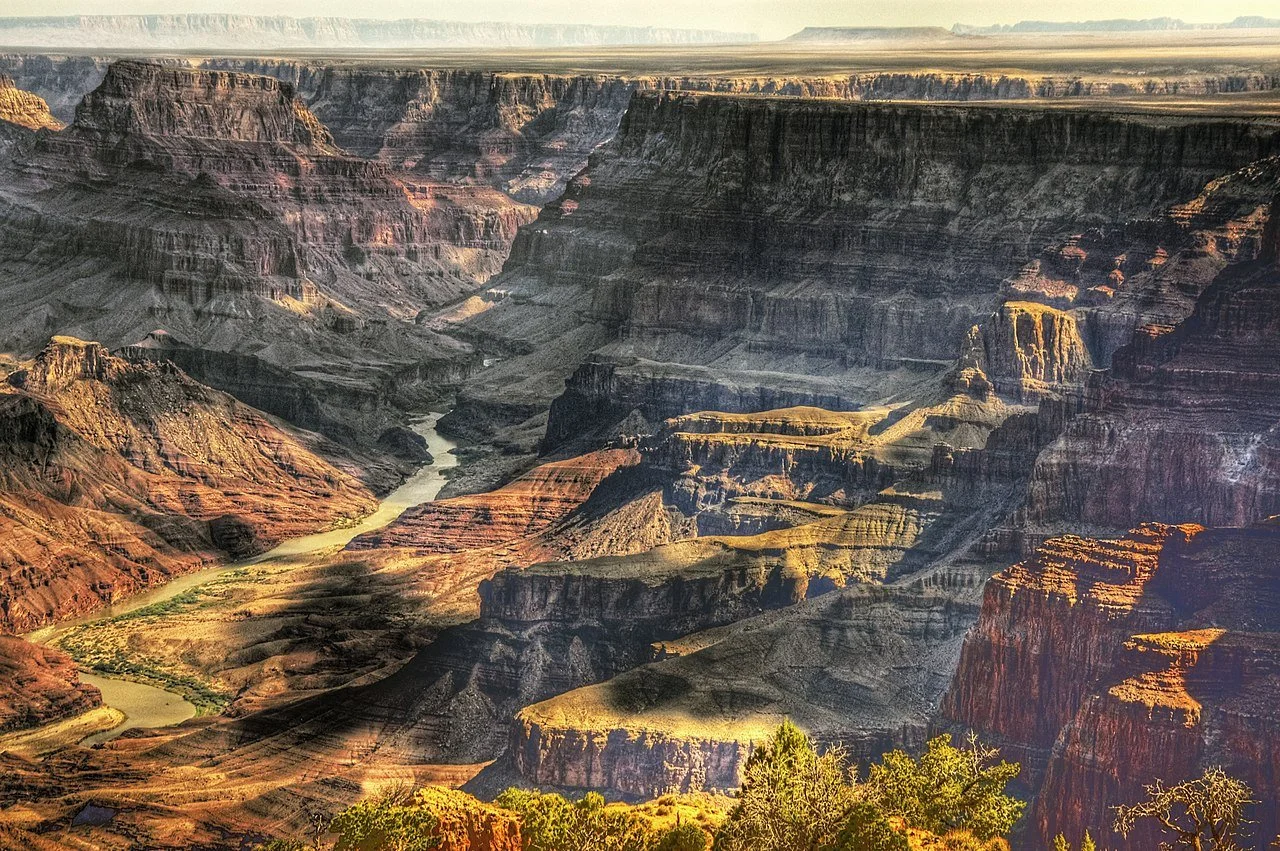
The Colorado River flows through the Grand Canyon, July 2006. Wolfgang Staudt from Saarbruecken, Germany, CC BY 2.0 <https://creativecommons.org/licenses/by/2.0>, via Wikimedia Commons
By Victoria Lu
Rivers are guardians of ecological health, yet they are among the least protected ecosystems in the United States. Crossboundary disputes, interagency regulations and statutes, and the vast ecological diversity of rivers make conservation extremely difficult. Land conservation faces numerous difficulties as well, yet the free-flowing nature of rivers and the transience of their inhabitants often lead to uniquely challenging legal disagreements.
A 2026 study published in Nature Sustainability reveals a startling statistic: only 11.7 percent of river lengths in the contiguous United States are adequately protected. Meanwhile, less than 19.3 percent of American waterways are protected at a level deemed viable by the National Protected Rivers Assessment of the United States. Despite over fifty years of federal regulation under the Clean Water Act, the vast majority of these ecological lifelines are legally vulnerable and inadequately protected or unprotected.
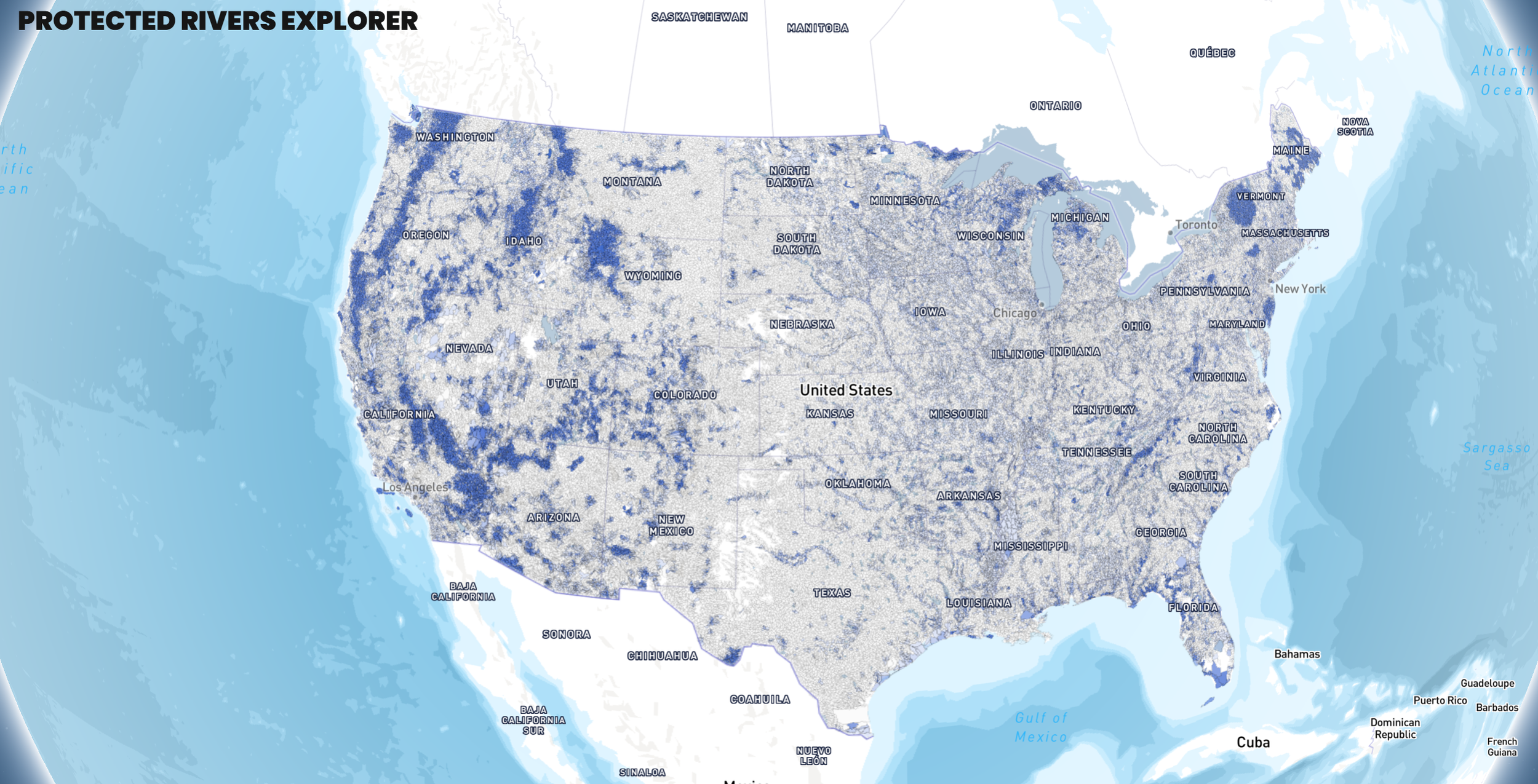
Snapshots of viable versus non-viable river protection systems depicted on American Rivers’ National Protected Rivers Assessment Tool. The blue figure (above) depicts “viable protection” systems (19.3% of American rivers). Viable protection is defined by the Protected River Index as rivers “whereby at least one-quarter of 5 key freshwater ecological attributes are intended for protection.” The 5 attributes are hydrologic regime, connectivity, water quality, habitat, and biotic composition. In this classification, comprehensively protected rivers make up only 0.9%, effectively protected rivers make up 8.4%, and limited protection rivers make up 10%, for a total of 846,295 river miles. (Note that this tool designates areas by geographic regions in which rivers and watersheds reside rather than showing the rivers or watersheds themselves, as the tool tracks which regions are and aren’t covered by legal protective frameworks.)
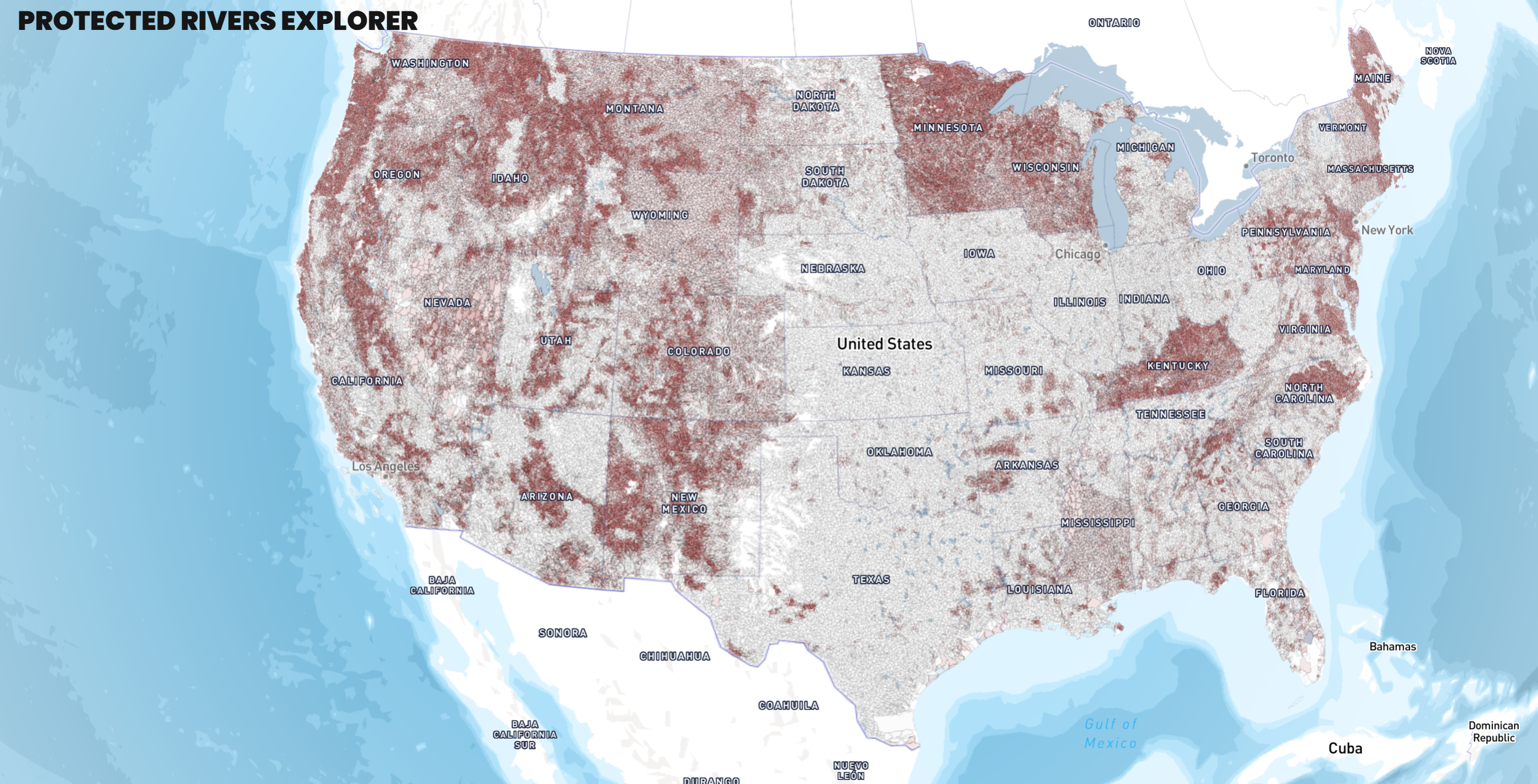
The above figure shows areas with “inadequate protection” per the National Protected Rivers Assessment Tool. (Note that this tool designates areas by geographic regions in which rivers and watersheds reside rather than showing the rivers or watersheds themselves, as the tool tracks which regions are and aren’t covered by legal protective frameworks.)
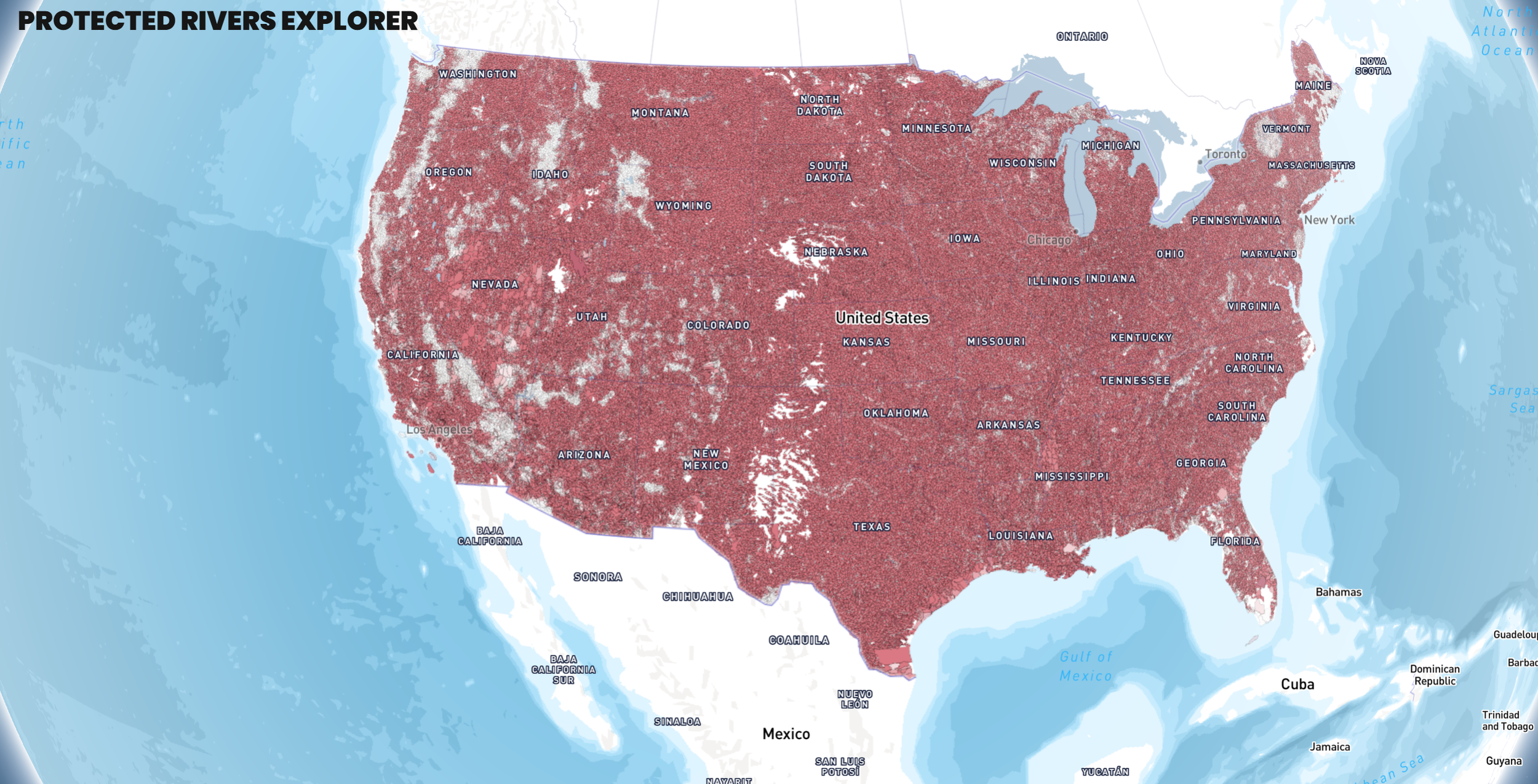
The above figure shows, in a vast mass of red, areas with “no protection” per the National Protected Rivers Assessment Tool. (Note that this tool designates areas by geographic regions in which rivers and watersheds reside rather than showing the rivers or watersheds themselves, as the tool tracks which regions are and aren’t covered by legal protective frameworks.)
The persistence of this gap in water protection suggests a fundamental flaw in how the American legal system categorizes Nature. Current U.S. law primarily views rivers and other elements of Nature as “natural resources” to be managed, rather than entities with independent value. This framework of object ownership has contributed to many arbitrary political boundaries that dissect rivers while ignoring watershed dynamics. It gives legal standing only to human entities, meaning rivers have no basis to sue for their own protection. In contrast, many Indigenous Peoples and Tribal Nations have long subscribed to a distinct worldview that treats rivers not as mere property, but as relatives or kin. As emphasized by tribal leaders and scholars, regarding rivers and other elements of nature as relatives creates a reciprocal obligation of care that is absent in modern American statutory law.
The U.S. failure to bridge these views has material consequences. Current river fragmentation leaves rivers vulnerable to deforestation, damming, pollution, extraction, and more. Stripping rivers of their ability to act as refuges for the health of our planet holds dire consequences for biodiversity, carbon sinks, and life on Earth.
This protection gap is a symptom of anthropocentric law. If our current regulatory framework were sufficient to halt river degradation and actively nurture conservation, fifty years of application of our landmark environmental statutes would have yielded better results. To secure the future of American rivers, we must be willing to test new legal frameworks. One is already waiting in the wings: Earth law, or ecojurisprudence.
Our Current Laws Are Failing Rivers
The United States features a complex overlay of federal, state, tribal, and private river protections. Ideally, these overlapping mechanisms would create a safety net for water systems. However, the 2026 study reveals that nearly two-thirds of U.S. rivers have zero formal protection. Current law overwhelmingly focuses on terrestrial governance rather than specifically targeting freshwater. Even in the sphere of international law, discussion of freshwater protection only appeared in the Convention on Biological Diversity in 2022.
In the U.S., land-based river protection manifests under the auspices of wilderness areas, national parks, and research natural areas. Meanwhile, the most effective systems are specifically targeted for rivers, such as Wild and Scenic Rivers designations. The 2026 study found that 47.1 percent of protected river lengths display more than one mechanism of protection—on average, 1.6 types—with river conservation systems being essential to the number.
Moreover, these gaps disproportionately affect specific types of waterways. While high-elevation rivers in iconic national parks often enjoy robust defense, low-elevation headwaters and intermittent streams (streams that do not flow year-round) are consistently underprotected. Statistically, intermittent streams are three times less likely to be protected than perennial (year-round) ones. Intermittent streams feed larger water bodies, particularly during springtime snow melt, and are essential for nutrient cycling and sediment transport. Such processes maintain wetland health, biodiversity, and ecosystem functions. They also aid in recharging underground aquifers, which are crucial for drinking water.
Below is a brief overview of major protected area types and statutes:
Protected water categories

A photo from 2018, the 50th Anniversary of the Wild and Scenic Rivers Act of 1968. GlacierNPS, Public domain, via Wikimedia Commons
Many U.S. environmentalists consider the National Wild and Scenic Rivers Act (1968) to be the nation’s strongest tool for river conservation. It explicitly prohibits the federal government from supporting actions that would modify a river’s free-flowing condition and protects “outstanding remarkable values” including scenic, recreational, and geological values. It is, however, very selective and requires an Act of Congress or Secretary of Interior approval, making for a slow process to approve new rivers.
The Clean Water Act (1972) is the primary federal statute governing water pollution. It utilizes the National Pollutant Discharge Elimination System (NPDES) to regulate point source pollution into “navigable waters.” Recent Supreme Court rulings such as Sackett v. EPA have narrowed the definition of “Waters of the United States,” leaving many intermittent streams and isolated wetlands without federal protection.
Protected land categories
National Parks offer the highest level of preservation, “unimpaired for future generations.” However, rivers often originate outside park boundaries and are vulnerable to pollution, dams, or extraction occurring upstream.
National Forests and Bureau of Land Management Lands are managed for “multiple uses,” meaning conservation competes with timber, grazing, and mining. Protection is often subject to administrative changes.
Riparian and floodplain mechanisms rely on fragmentation of FEMA standards that usually prioritize flood insurance and voluntary tools like conservation easements.
Current statutory tools are insufficient to close the protection gap. The Clean Water Act, while pivotal in environmental law, protects only about 2.7 percent of river miles in terms of strict conservation standards, while the Wild and Scenic Rivers Act covers roughly 2 percent. Even in states such as Alaska, which is ranked in the 2026 article as among the highest for “viable protection,” statistics mask the reality of threats from extractive projects like Pebble Mine and the collapse of chum salmon in the Yukon.
Even where protections exist, they often suffer from the “paper park” problem. This term, coined in a 1999 World Wildlife Fund report, describes legally established protected areas where experts believe current actions are insufficient to halt degradation. Because water flows across boundaries, “paper rivers” are only as protected as far as the laws are enforced.
The Inadequacy of Anthropocentric Law
The inability of the current legal system to close protection gaps for rivers is not merely a failure of enforcement—it is one of design. U.S. environmental law is anthropocentric, case-based, and largely reactive rather than preventative. It is designed to manage how humans use Nature rather than support Nature’s legal standing itself. Modern environmental law stems from public nuisance law, defined as significant interference with public health, safety, and comfort; illegal activity; or of a continuing nature that has a lasting effect on public rights. Only after industrial pollution brought major cases to court did the earliest forms of legal environmental protection form. But these laws seldom originated from a desire to protect Nature. Major statutes like the Clean Water Act oftentimes simply regulate harm rather than prohibit it. For instance, permits for specific amounts of pollution legalize the degradation of a river within human-defined limits.
Additionally, arbitrary political boundaries slice rivers into disparate segments. Rivers are holistic and connected systems, yet they are privy to private property rights and differing boundary laws. Case law highlights this fragmentation. In Missouri v. Illinois (1906), the Supreme Court established a high burden of proof for states suing over interstate pollution. The ruling affirmed the treatment of rivers as conduits for waste, as well as making it difficult for future cases to be brought against upstream polluters. Later, LA County Flood Control District v. NRDC ruled that the flow of pollutants within a single water body is not a “discharge” requiring a permit, further limiting the law’s ability to address internal degrading.
Only in exceptional cases does environmental protection take precedence over economic development. In the landmark Tennessee Valley Authority v. Hill (1978) case, the Supreme Court halted the nearly completed Tellico Dam to protect the endangered snail darter, a small fish species. The decision, written by Chief Justice Warren Burger, emphasized that the Endangered Species Act intended to place the survival of species above economic considerations. Chief Justice Burger famously wrote that "the plain intent of Congress in enacting this statute was to halt and reverse the trend toward species extinction, whatever the cost." This stance, where a species’ right to exist trumps even millions of dollars in construction costs, remains anomalous in U.S. law.
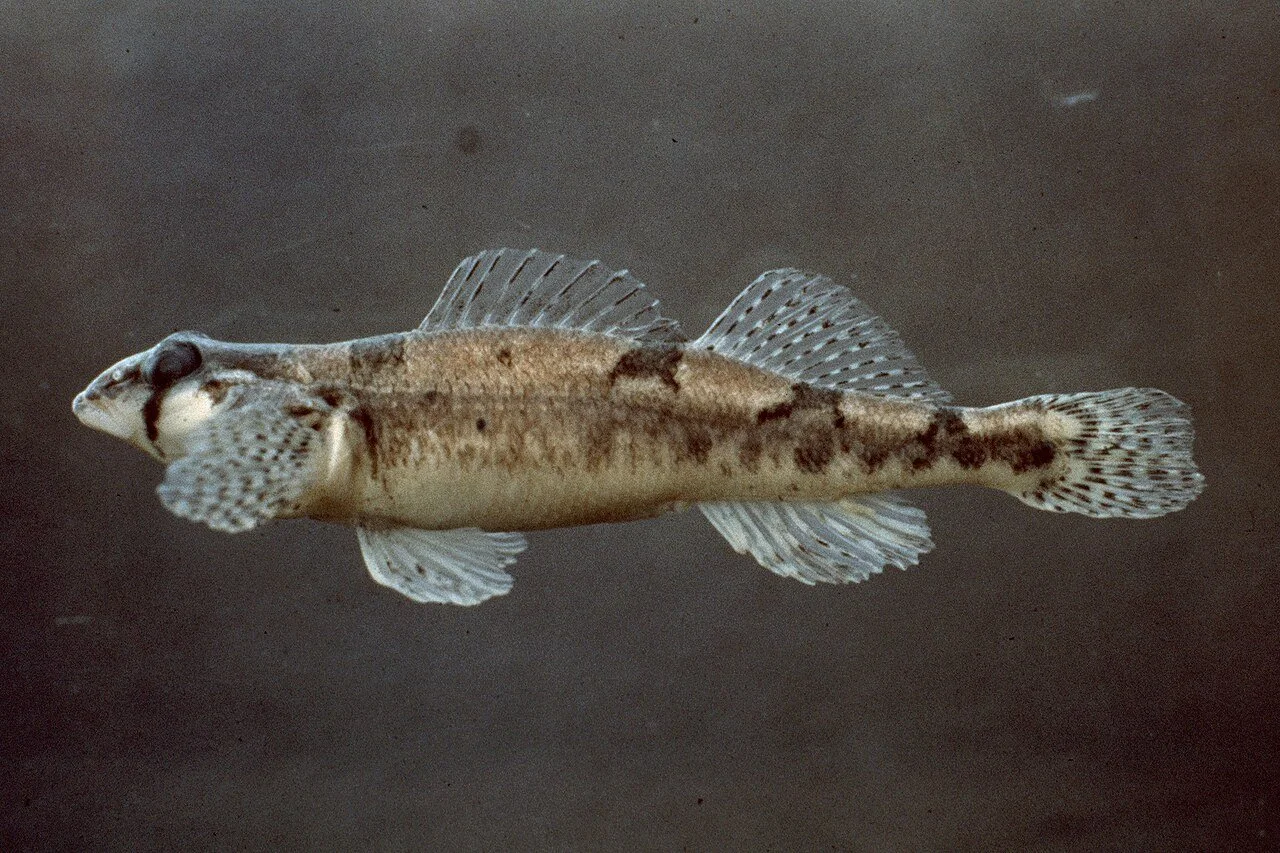
Snail darter (Percina tanasi). Jerry A. Payne, USDA Agricultural Research Service, Bugwood.org, CC BY 3.0 US <https://creativecommons.org/licenses/by/3.0/us/deed.en>, via Wikimedia Commons
More commonly, American water law falls victim to the “tragedy of the commons,” a term coined by ecologist and microbiologist Garret Hardin in 1968. In this model, individuals acting in their own rational self-interest will inevitably deplete a shared resource, even if it is against the long-term interests of the group. Under current law, the "river" is the commons, and the state acts as the regulator trying to manage competing interests in the river. However, because the river lacks standing, it is often carved up by private property rights and state lines that prevent conservation management.
Political scientist Elinor Ostrom later challenged Hardin’s analysis, writing that communities can and do successfully manage common-pool resources without top-down state control or privatization. In her seminal work Governing the Commons (1990), Ostrom argued that sustainable management occurs when local communities have a direct stake in the resource and the authority to create their own rules for its care, what she called polycentric governance.
This is where Earth law offers a bridge. Our current regulatory agencies are often too distant and fragmented to act as effective stewards. By granting rivers legal rights and appointing appropriate local guardians (a model supported by Ostrom’s findings on community stewardship), we can shift from a tragedy of open access to relationships of reciprocal care.
How Ecocentric Law Can Be A Solution
A rights-based model could be the solution to America’s flawed resource-based model. Earth law moves from regulating property to recognizing the inherent rights of natural entities to exist, flourish, and regenerate.
In 2017, Earth Law Center released the Universal Declaration of the Rights of Rivers. This declaration creates a baseline of fundamental rights, including the right to flow, the right to perform essential ecosystem functions, the right to be free from pollution, and the right to restoration.
Operationally, this can be achieved through different means as is appropriate to a culture and jurisdiction, including Indigenous customary governance, a well-considered statutory scheme implemented by an informed guardianship body, or legal personhood. Just as a corporation or a ship can have legal standing in court represented by human attorneys, a river with legal personhood can be represented by human guardians. This grants the river "standing," allowing it (via its guardians) to sue polluters directly for violating its rights, rather than relying on a human to prove they were personally harmed by the pollution.
While Earth law is often viewed as a radical departure from Western law, it is actually the logical extension grounded in the work of law professor Christopher Stone and “geologian” Thomas Berry. In his seminal 1972 essay, “Should Trees Have Standing?,” Stone dismantled the argument that Nature could not hold rights simply because it could not speak. He drew a parallel to other voiceless entities, such as corporations, which the law had by then long recognized as "persons" capable of having legal standing. In The Great Work (1999), Berry argued that the root of our ecological crisis is a crisis of perception: we view the universe as “it” rather than “thou.” As long as the law categorizes a river as an object, it will be used for utility.
It is crucial to acknowledge that while Earth law is framed in Western legal terms, it draws upon Indigenous worldviews with centuries of continuity. Tlingit and Athabascan Peoples, for example, record long oral histories of glaciers as sentient beings that actively respond to human actions—for instance, taking offense at fat being cooked nearby. In mid-2025, the Yurok Tribe reclaimed its sacred lands around the Klamath River and immediately designated it as a salmon sanctuary and community forest. Many Indigenous Nations have passed resolutions and legal documents recognizing the right of Nature to exist, which are documented on the Ecojurisprudence Monitor. For instance, the Ponca Nation passed a 2022 resolution recognizing the immutable Rights of the Ní'skà and Arkansas Rivers.
What Are the Potentials of Earth Law?
Skeptics of Earth law say that there are so few long-term examples of Rights of Nature in the U.S. that we lack substantive data to prove this legal framework yields better environmental outcomes than mainstream regulation. This argument is valid, yet it ignores the information we do have regarding the status quo.
We have over fifty years of data on the current regulatory system. Despite the Clean Water Act, the Wild and Scenic Rivers Act, and billions of dollars in agency spending, only 11.7 percent of US rivers are adequately protected. In scientific terms, the control group (anthropocentric regulation) has demonstrated a failure rate of nearly 90 percent. If a medical treatment failed 90 percent of the time after 50 years, we would not hesitate to run a clinical trial on a new approach. It is time to treat Earth law not as a radical ideology, but as a necessary paradigm shift.
And it may not be much longer until the movement begins to have the data to back up its claims.
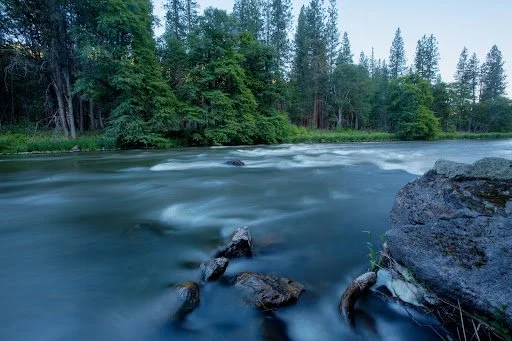
Snapshot of the Klamath River. Bureau of Land Management Oregon and Washington. Public domain, via Wikimedia Commons
In the northwest U.S., the Klamath River, after being reclaimed by the Yurok Tribe, has shown significant improvements in water quality and ecological health after the removal of four dams opened up over 400 miles of habitat. The Yurok Tribe reported that major decreases in toxins such as heavy metals, microcystin, and suspended sediments have been observed since 2024. Fish populations are also expected to recover over time, and will continue to be monitored by the Yurok Tribe Environmental Department. In late 2024, more than 7000 Chinook salmon were recorded swimming upriver to access habitat previously blocked off by dams. As more time passes for scientists to measure trends, it is expected that the Klamath River will continue improving in its health.
Internationally, the Whanganui River in New Zealand provides a governance template. Since the passage of the Te Awa Tupua Act in 2017, the river has not only gained legal personhood but has operationalized it through Te Pou Tupua (a human face for the river). This has shifted the power dynamic. Agricultural and hydroelectric interests can no longer merely consult a regulator. They must negotiate with the river as an equal stakeholder.
Organizations like Ecoforensic are additionally creating the methodology to support these legal frameworks, training local para-ecologists to collect the biological and hydrological data needed to defend rivers’ rights in court.
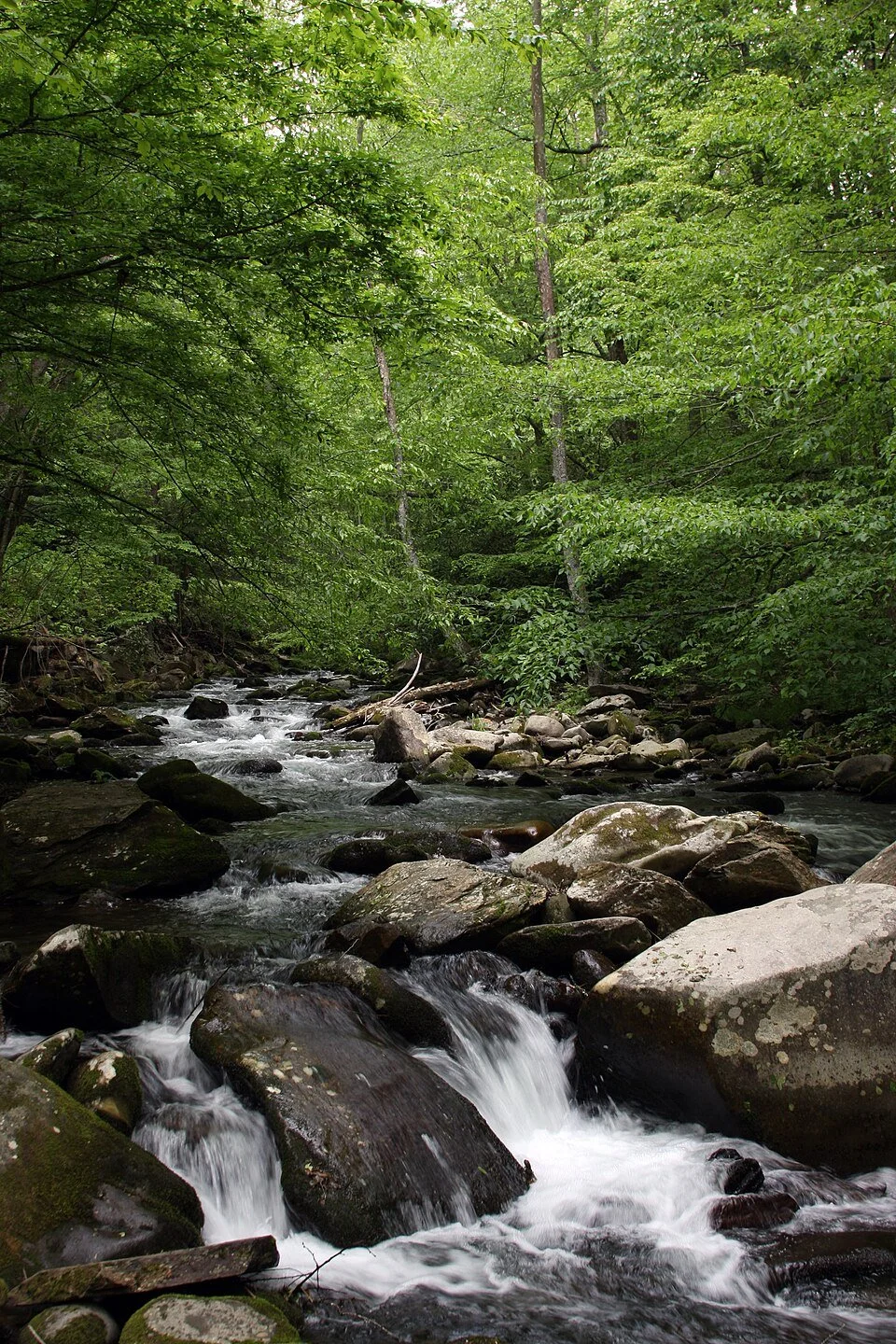
Oconaluftee River, in Great Smoky Mountains National Park, North Carolina. Ianaré Sévi, CC BY-SA 3.0 <https://creativecommons.org/licenses/by-sa/3.0>, via Wikimedia Commons
In the United States, an increasing number of rights of rivers initiatives are being led by Tribal Nations. On January 8, 2026, the Eastern Band of Cherokee Indians (EBCI) Tribal Council unanimously passed a historic Rights of Nature resolution for the Longperson (Ganvhidv Asgaya, the Oconaluftee River and its interconnected water system). Stretching over 790 miles from the Great Smoky Mountains to the sea, the Longperson is the longest river system east of the Mississippi to have its rights formally recognized. The resolution was drafted and presented by the North American Indian Women’s Association (NAIWA) Daughters and marked the first all-women-led Rights of Nature resolution passed in the United States.
Rather than framing the river as a "resource" to be managed, the Cherokee youth anchored the legislation in the understanding that the Longperson is a living entity and a relative who provides physical and spiritual health to the community. Recognizing that they could not have a discussion about their relative without their relative present, the NAIWA Daughters gathered water from the Longperson in traditional clay pots and brought the river into the council chambers. Following the unanimous vote, the water was returned to the Oconaluftee River in a traditional ceremony.
The resolution explicitly recognizes, among others, the Longperson's inherent rights to:
Exist, persist, and regenerate its vital cycles free from negative human disturbance
Be free from pollution, contamination, and non-native invasive species
Serve as a home and habitat for non-human relatives
Maintain free-flowing conditions, including strict protection from damming, obstruction, or flow alteration.
The NAIWA Daughters did not stop at a symbolic declaration. The group is collaborating with the Tribal Council to establish a formal Tribal Rights of Nature Task Force, which will be charged with actively monitoring the Longperson's health and guiding the implementation of the resolution.
Examining this as a case study illustrates the core of Earth jurisprudence. By shifting the legal framework from objectified property extraction to one of reciprocal relationship and guardianship, we can create stronger protections for America's rivers.
Implementation
Growing Earth law from its roots in tribal resolutions and local ordinances all the way to enforceable state and federal law requires navigating a complex system of corporate pushback and legal standing.
The largest hurdle is preemption. When local communities pass Rights of Nature ordinances, often with the help of groups like the Community Environmental Legal Defense Fund (CELDF), they routinely face aggressive pushback. In Florida, after Orange County voters overwhelmingly passed the Wekiva and Econlockhatchee River Bill of Rights, the state legislature swiftly passed a preemption law banning localities from granting legal rights to Nature.
It is important to acknowledge the historical nuance of preemption: local authority is not always historically benign (as seen in the "states' rights" arguments used to defend slavery). Earth law must navigate this complicated relationship, and it can offer a balancing mechanism. By establishing that Nature possesses inherent and unalienable rights, a Rights of Nature framework dictates that higher courts should step in not to defend corporate exploitation, but to prevent local or state actors from violating fundamental ecological rights.
For the movement to survive this pushback, it must achieve broader systemic recognition. State legislatures should consider affirming local RoN ordinances to build regional coalitions. To track success and prove viability, human guardians appointed to represent rivers should consider adopting the five ecological indices from the 2026 Nature Sustainability study—hydrologic regime, connectivity, water quality, habitat, and biotic composition—as their standard metrics for assessing whether a river's rights are being upheld.
As states stall, Tribal Nations are filling the void. In late 2025, the Colorado River Indian Tribes (CRIT) designated the Colorado River as a "living being" with legal rights. As CRIT Chairwoman Amelia Flores noted, "We must think beyond terms of what it can provide to us; we must think of what we can provide to it." The Tribe’s senior water rights on the lower Colorado River, recognized by the Supreme Court Decree Arizona v. California, gives this designation profound legal weight in the drought-stricken Southwest. Outside entities such as nearby Phoenix would be obligated to sign agreements that acknowledge the importance of the river before leasing water. Moreover, unlike town ordinances that often incite legal backlash, tribal ordinances may be perceived differently because they focus on human relationships with Nature, not pure legal rights. The future intersections of tribal law and outside players stand to be heavily influenced by CRIT’s efforts.
Ultimately, federal law must evolve. A practical entry point is amending the Wild and Scenic Rivers Act (Public Law 90-542). Shifting the Act from a static preservation model to a rights-based model would automatically grant legal standing and guardianship councils to America's waterways, providing a federal testing ground for Earth law.
The 11.7 percent protection rate of U.S. rivers is not just a statistic; it is an indictment of a legal system that views the natural world as a warehouse instead of a living entity. By embracing Earth jurisprudence, we can experiment with a promising new approach to closing the river protection gap. The legal mechanisms—guardianship, legal personhood, and constitutional rights—already exist. The ecological metrics to track their success are readily available. What remains is a shift in perspective. To secure the future of our rivers and home, we must recognize that the river is not a "what," but a "who."
Sources
Agricultural Conservation Easement Program (ACEP) | Natural Resources Conservation Service. (2026, February 17).https://www.nrcs.usda.gov/programs-initiatives/agricultural-conservation-easement-program
An Update on the Yukon River Salmon Crash. (n.d.). Alaska Public Media. Retrieved February 27, 2026, fromhttps://alaskapublic.org/programs/trouble-at-sea/yukon-river
Anderson, B. (2026, January 9). A first-of-its-kind assessment asks: How protected are America’s rivers? - Conservation Science Partners.https://csp-inc.org/a-first-of-its-kind-assessment-asks-how-protected-are-americas-rivers/
Bioneers. (2026, January 23). Eastern Band of Cherokee Indians Pass Historic Youth-Led Rights of Nature Resolution. Bioneers.https://bioneers.org/eastern-band-of-cherokee-resolution/
Bureau of Land Management (BLM) | USAGov. (n.d.). Retrieved February 27, 2026, fromhttps://www.usa.gov/agencies/bureau-of-land-management
celdf. (2020, November 4). CELDF Statement on Orange County, FL ‘Rights of Nature’ Law. CELDF - Community Rights Pioneers - Protecting Nature and Communities.https://celdf.org/2020/11/celdf-statement-on-orange-county-fl-rights-of-nature-law/
CELDF - Community Rights Pioneers—Protecting Nature and Communities. (n.d.). CELDF - Community Rights Pioneers - Protecting Nature and Communities. Retrieved February 27, 2026, fromhttps://celdf.org/
Christopher Stone. (2010). Should Trees Have Standing?: Law, Morality, and the Environment (3rd ed.). Oxford University Press. (Original work published 1972)
Comte, L., Olden, J. D., Littlefield, C., Dickson, B. G., Zablocki, J., & Moryc, D. (2026). National assessment of river protection in the United States. Nature Sustainability, 1–12.https://doi.org/10.1038/s41893-025-01693-8
Dudley, N., & Stolton, S. (1999). Threats to forest protected areas: Summary of a survey of 10 countries carried out in association with the World Commission on Protected Areas.https://portals.iucn.org/library/node/12594
Earth Law Center and Rights of Nature Timeline. (n.d.). Earth Law Center. Retrieved February 27, 2026, fromhttps://www.earthlawcenter.org/timeline
Earth Law Center FAQ | Understanding The Fight For Nature. (n.d.). Earth Law Center. Retrieved February 27, 2026, fromhttps://www.earthlawcenter.org/faq
Eastern Band of Cherokee Tribal Resolution: Rights of the Longperson Water System. (n.d.). Eco Jurisprudence Monitor. Retrieved February 27, 2026, fromhttps://ecojurisprudence.org/initiatives/eastern-band-of-cherokee-usa-tribal-resolution-rights-of-the-longperson-watersytem/
Eco Jurisprudence Monitor. (n.d.). Retrieved February 27, 2026, fromhttps://ecojurisprudence.org/?map-style=political
ecoforensic_admin. (n.d.). Ecoforensic – Defending Rights of Nature. Ecoforensic. Retrieved February 27, 2026, fromhttps://ecoforensic.org/
Elinor Ostrom. (1990). Governing the Commons. Cambridge University Press.https://doi.org/10.1017/CBO9780511807763 (Original work published 1990, Cambridge University Press)
Floodplains and Wildlife Conservation | FEMA.gov. (n.d.). Retrieved February 27, 2026, fromhttps://www.fema.gov/floodplain-management/wildlife-conservation
Groundbreaking Women-Led Rights of Nature Resolution Passed by Eastern Band Cherokee. (n.d.). Earth Law Center. Retrieved February 27, 2026, fromhttps://www.earthlawcenter.org/blog-entries/2026/1/groundbreaking-women-led-rights-of-nature-resolution-passed-by-eastern-band-cherokee
Hofschneider, A. (2025, June 5). In California’s largest landback deal, the Yurok Tribe reclaims sacred land around Klamath River. Grist.https://grist.org/indigenous/in-californias-largest-landback-deal-the-yurok-tribe-reclaims-sacred-land-around-the-klamath-river/
Klamath River Runs Free for First Time in a Century as Largest Dam Removal in US History Nears Completion. (2024, August). Native Fish Society.https://nativefishsociety.org/news-media/klamath-river-runs-free-for-first-time-in-a-century-as-largest-dam-removal-in-us-history-nears-completion
KUNC, B. A. H. (2025, August 26). The Colorado River Is This Tribe’s ‘Lifeblood,’ Now They Want To Give It the Same Legal Rights as a Person. Inside Climate News.https://www.kunc.org/news/2025-08-20/the-colorado-river-is-this-tribes-lifeblood-now-they-want-to-give-it-the-same-legal-rights-as-a-person
Looks Good on Paper: Addressing the Problem of “Paper Parks” – WildAid Marine. (n.d.). Retrieved February 27, 2026, fromhttps://marine.wildaid.org/looks-good-on-paper-addressing-the-problem-of-paper-parks/
Los Angeles County Flood Control Dist. V. NRDC, 568 U.S. 78 (2013). (n.d.). Justia Law. Retrieved February 27, 2026, fromhttps://supreme.justia.com/cases/federal/us/568/78/
Missouri v. Illinois, 200 U.S. 496 (1906). (n.d.). Justia Law. Retrieved February 27, 2026, fromhttps://supreme.justia.com/cases/federal/us/200/496/
Mitch Distin. (n.d.). The Indigenous Notions of Kincentricity and Reciprocity: The Keys To Sustainability and Climate Change. Retrieved February 27, 2026, fromhttps://www.prosocial.world/posts/the-indigenous-notions-of-kincentricity-and-reciprocity-the-keys-to-sustainability-and-climate-change
Movement Rights—Indigenous Led Rights of Nature. (2022, June 28).https://movementrights.org/
National Park System (U.S. National Park Service). (n.d.). Retrieved February 27, 2026, fromhttps://www.nps.gov/aboutus/national-park-system.htm
National Protected Rivers Assessment Explorer. (n.d.). Retrieved February 27, 2026, fromhttps://www.americanrivers.org/npra-explorer/
NPS Organic Act | U.S. Department of the Interior. (2015, December 10). [Site page].https://www.doi.gov/ocl/nps-organic-act
Olden, J. D., Comte, L., Littlefield, C., Dickson, B. G., Zablocki, J., & Moryc, D. (2026). Safeguarding, strengthening and expanding river protections for nature and people. Nature Sustainability, 1–2.https://doi.org/10.1038/s41893-025-01722-6
Orange County (USA) Ordinance: Rights of the Wekiva and Econlockhatchee Rivers. (n.d.). Eco Jurisprudence Monitor. Retrieved February 27, 2026, fromhttps://ecojurisprudence.org/initiatives/wekiva-and-econlockhatchee-river-bill-of-rights-right-to-clean-water-charter-amendment/
Pebble Mine. (n.d.). Bristol Bay Native Corporation. Retrieved February 27, 2026, fromhttps://www.bbnc.net/about/pebble-mine/
Ponca Nation (USA) Resolution: Rights of rivers. (n.d.). Eco Jurisprudence Monitor. Retrieved February 27, 2026, fromhttps://ecojurisprudence.org/initiatives/ponca-nation-statute-recognizing-rights-of-rivers/
Public nuisance. (n.d.). LII / Legal Information Institute. Retrieved February 27, 2026, fromhttps://www.law.cornell.edu/wex/public_nuisance
Ranjan, R., & Borchgrevink, A. (2025). Riverine rights: Tracing the currents and consequences of legal innovations in the rights of rivers. The International Journal of Human Rights, 0(0), 1–5.https://doi.org/10.1080/13642987.2025.2519590
September 27, U., December 18, 2023 •, & 2008. (n.d.). States’ Rights. American Battlefield Trust. Retrieved February 27, 2026, fromhttps://www.battlefields.org/learn/articles/states-rights
Staff, K. G., CalTrout. (2025, October 9). A River Reborn: One Year After Klamath River Dam Removal. California Trout.https://caltrout.org/news/1-year-anniversary-klamath-dams/
Te Awa Tupua (Whanganui River Claims Settlement) Act 2017 No 7 (as at 27 August 2025), Public Act – New Zealand Legislation. (n.d.). Retrieved February 27, 2026, fromhttps://www.legislation.govt.nz/act/public/2017/0007/latest/whole.html
Tennessee Valley Auth. V. Hill, 437 U.S. 153 (1978). (n.d.). Justia Law. Retrieved February 27, 2026, fromhttps://supreme.justia.com/cases/federal/us/437/153/
The National Wild & Scenic Rivers System | Rivers.gov. (n.d.). Retrieved February 27, 2026, fromhttps://rivers.gov/about
The New Zealand river that became a legal person. (2020, March 20).https://www.bbc.com/travel/article/20200319-the-new-zealand-river-that-became-a-legal-person
Thomas Berry. (1999). The Great Work: Our Way Into The Future. Harmony/Bell Tower.
Tragedy of the Commons: Examples & Solutions | HBS Online. (2019, February 6). Harvard Business School.https://online.hbs.edu/blog/post/tragedy-of-the-commons-impact-on-sustainability-issues
Unit, B. (2024, October 1). Kunming-Montreal Global Biodiversity Framework. Secretariat of the Convention on Biological Diversity.https://www.cbd.int/gbf
Universal Declaration of River Rights | Earth Law Center. (n.d.). Earth Law Center. Retrieved February 27, 2026, fromhttps://www.earthlawcenter.org/river-rights
US EPA, O. (2013, February 22). Summary of the Clean Water Act [Overviews and Factsheets].https://www.epa.gov/laws-regulations/summary-clean-water-act
US EPA, O. (2015, October 28). Learn About Streams [Overviews and Factsheets].https://www.epa.gov/cwa-404/learn-about-streams
What are the differences between National Parks and National Forests? (n.d.). National Forest Foundation. Retrieved February 27, 2026, fromhttps://www.nationalforests.org/blog/what-are-the-differences-between-national-parks-and-national-forests
World Wildlife Fund International. (2004). How effective are protected areas? A preliminary analysis of forest protected areas by WWF – the largest ever global assessment of protected area management effectiveness.
Yurok Tribe. (n.d.). Yurok Tribe—Water quality in the lower Klamath River has... | Facebook. Facebook. Retrieved February 27, 2026, fromhttps://www.facebook.com/TheYurokTribe/posts/pfbid0BC7cNqmojDGf1FjFo63q5YMq9N9X3PwFfcRALurndG6o4qjVvxNf3hkMYcobqsyvl?rdid=SPJKZou30mi9iTrK#
Legal cases
Missouri v. Illinois, 200 U.S. 496 (1906)
Los Angeles County Flood Control Dist. v. NRDC, 568 U.S. 78 (2013)
Tennessee Valley Auth. v. Hill, 437 U.S. 153 (1978)

.jpg)