
Groundbreaking Women-Led Rights of Nature Resolution Passed by Eastern Band Cherokee
By Juniper Lee
On January 8th, 2026, the Eastern Band of Cherokee Indians Tribal Council unanimously approved a Rights of Nature (RoN) resolution for the Longperson, a 790 mile interconnected water system whose headwaters begin in the Great Smoky Mountains and whose feet stretch to the sea.
The resolution was presented by the North American Indian Women’s Association (NAIWA) Daughters, an all-female, youth-led group of Indigenous environmental protectors and advocates. NAIWA Daughters shared a moving testimonial to the council as the culmination of 18 months of community outreach, research, prayer, and hard work. This historic event marks the first all-women-led RoN resolution passed in the United States.
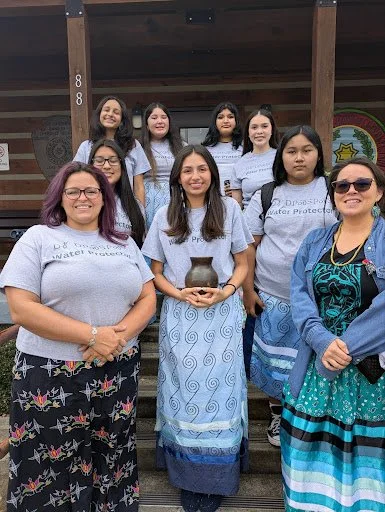
Junior NAIWA Daughters stand with the Longperson (in clay pot) before the Eastern Band of Cherokee Council. Back row: Janée Smith, Zailiana Blythe, Laila Crowe-Taylor, Misha Slee. Second row: Kyndra Postoak, Marijane Tafoya. Front row: Kimberly Smith (mentor), Jasmine Smith, Malia Crowe (mentor).
Reciprocity and Honoring of the Longperson
The Longperson, also known as Ganvhidv Asgaya, is a being who provides spiritual and physical health to the Cherokee people. The Longperson holds significance in many cultural rituals and in supporting the tribe’s emotional wellbeing. Since 2021, Eastern Band Cherokee have recognized a day each year on which they specially honor Longperson. This day serves as an opportunity to reconnect with the land, clean up the river, and experience cultural reawakening. Reciprocity to Earth systems is instilled as a core value for the Eastern Band Cherokee—understanding that it is the responsibility of the Eastern Band Cherokee to protect Longperson, as it protects them.
The Eastern Band of Cherokee Indians are one of three federally recognized Cherokee tribes. They are a sovereign nation with powers of self determination. The NAIWA Daughters’ goal is to empower and inspire Indigenous women, promote intertribal communications, and enhance cultural enrichment.
Rights of Nature Is Not New
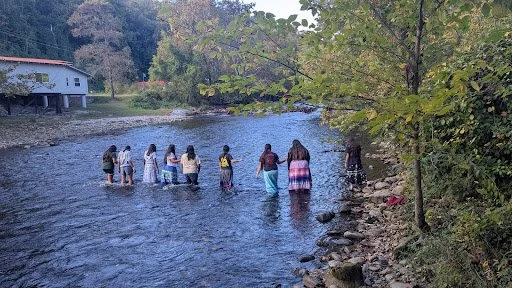
NAIWA Daughters standing with Longperson
Rights of Nature is a legal and cultural movement that strives to harmonize the relationship between humans and the more-than-human world. It recognizes that in order to address environmental issues, Nature needs a seat at the table—in courts, legislation, administrative bodies, and beyond. Indigenous worldviews and leadership have proven central to the movement’s success.
The NAIWA Daughters offered their protection to Longperson through RoN by applying an ecocentric framework to environmental law and conservation. The effort was collaborative and deeply rooted in Indigenous knowledge. In its early January meeting, NAIWA Daughters shared powerful and moving statements to the council. A press release from the Global Alliance for the Rights of Nature says the meeting attracted a virtual audience of around 10,000 onlookers and filled the building with supporters.
At the meeting, Jasmine Smith, Chair of NAIWA Daughters said, regarding RoN, “This is not new . . . this is memory, this is identity, this is Cherokee.”
Kendra Posthoke, another member of NAIWA Daughters, emphasized that the resolution would contribute to a larger effort of maintaining and rebuilding the relationship between humans and non-human entities.
The NAIWA Daughters recognized that the conversation they had that day would only feel right if Longperson was present in the meeting. Members gathered Longperson in two clay pots, returning them to the Oconaluftee River later that day in a water ceremony.
An important part of the process was to ensure that the community felt the work they were doing was accessible and relatable. Their outreach included educational efforts, informing tribal members about RoN. Smith says the resolution reflects deep personal connections to Longerson. Not only for current individuals within the community but also for their ancestors, who advocated for the Longperson and understood its interconnectedness to Cherokee identity.
The resolution recognizes five inherent rights of the Longperson:
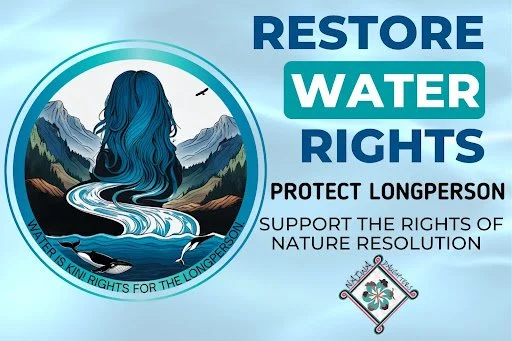
Posted by NAIWA daughters Cherokee Facebook page Jan. 7th, 2026
1. To exist, persist, and regenerate its vital cycles, structures, functions, and processes free from negative human disturbance, alteration, or destruction.
2. To maintain and restore its natural state and integrity, including the right to be free from pollution, contamination, nonnative invasive species, and other environmental degradation.
3. To serve as a home and habitat for non-human relatives, consistent with the ecological relationships established through time.
4. To access and maintain free-flowing conditions, including protection from damming, obstruction, or any alteration that impedes the natural flow of water.
5. To be protected by the Eastern Band of Cherokee under the laws, customs, and traditions of the Eastern Band of Cherokee, and to have its rights enforced by the appropriate authorities.
After compelling and poignant testimonies from members of the NAIWA Daughters, emotions swelled in the chamber room as the council was asked to vote. All members stood and applauded, unanimously passing the resolution.
As youth, the NAIWA Daughters acknowledge that the world they inherit is one with a multitude of ecological challenges. Accessible, clean, and free-flowing water is an inherent right, essential not only for ecosystems but for human survival. Following the resolution, NAIWA Daughters plan to collaborate with the Tribal Council to create a task force charged with monitoring the Longperson’s health. They hope that the resolution can inspire other Indigenous and non-Indigenous groups to implement their own RoN initiatives in other regions.