
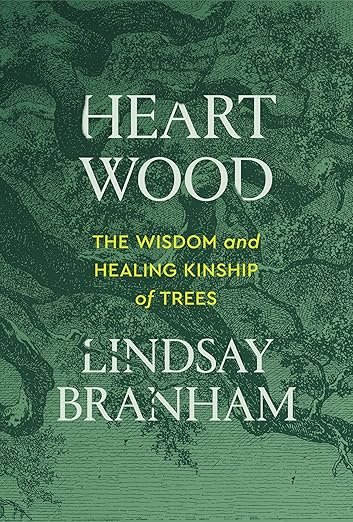
A Conversation with Lindsay Branham, Author of New Book “Heartwood: The Wisdom and Healing Kinship of Trees”
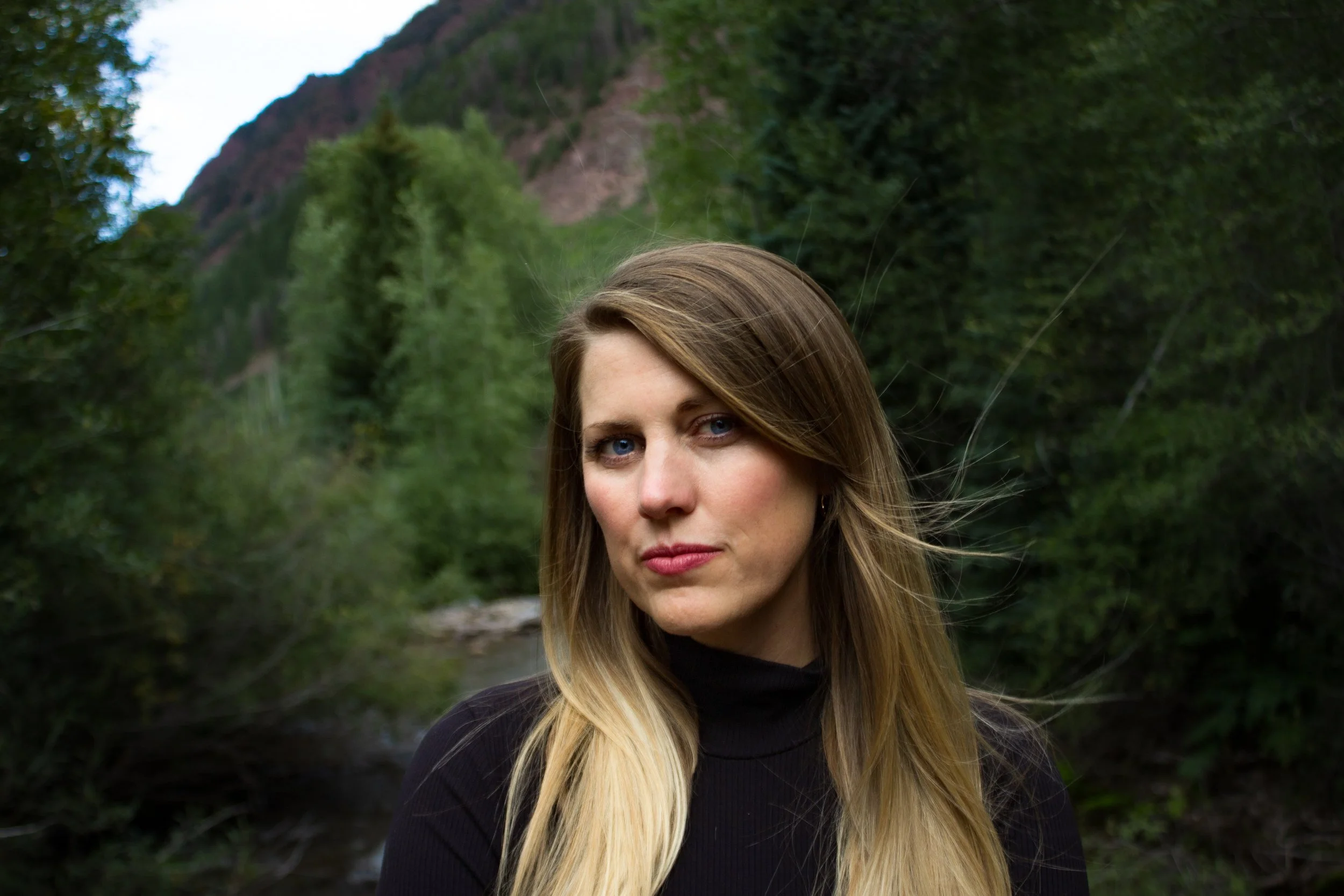
Lindsay Branham is an environmental psychologist, Emmy-nominated filmmaker, and founder of NOVO and The Heartwood Institute, initiatives that address ecological and human rights crises through film, culture, and community engagement. With a PhD in Psychology from Cambridge, her work explores how humans can restore a sense of kinship with the living world, weaving together environmental psychology, storytelling, spirituality, and ecology.
Earth Law Center has been collaborating with Lindsay on initiatives related to the rights of rivers and broader efforts to reimagine our legal and cultural relationship with nature.
Lindsay’s new book, released on March 10, 2026, is The Wisdom and Healing Kinship of Trees (Hachette).
***
Interview by Earth Law Center intern Isabel Fluckiger
Part I. Who Is Lindsay Branham?
Q: You developed a chronic illness during wildfire season. Can you share what drew you specifically to the forests and the natural world as a place of solace and learning?
A: Like all good things in my life, my relationship with trees is mostly a mystery. But it also feels like a miracle. I can't explain why I was drawn to trees, exactly, except that they captured my full attention. And while living within a very sick body, I was more willing to let what drew my presence be a guiding compass. The wonderful mystic Simone Weil famously said that “prayer is unmixed attention.” Perhaps the trees prayed me into noticing them, in some ways, for the first time. Practically how that unfolded is that during lockdown, my parents had surprisingly decided to move from California to the edge of the White River National Forest in Colorado. I was not traveling internationally for work due to the global pause, and I was also really struggling with a cacophony of difficult physical symptoms. While visiting them, I started going on very long wanders throughout the White River National Forest. I quite quickly became entranced, enchanted, and entwined into their embrace. The trees cast a spell on me. And an odyssey of relationship unfolded between us.
Q: Your background in film has taken you around the globe, witnessing some of humanity’s most pressing challenges. How has that shaped your understanding of humans not as separate from nature, but as an enmeshed facet of it?
A: I’ve reported on some of the most complex human rights challenges around the world. From children in armed conflict in DR Congo to conflict minerals, the last and largest elephant population in Central Africa, bonded labor in India and more. I have witnessed first hand that the wellbeing or flourishing of people is linked to people around the world and to the environments we tend to or neglect. The fact that my ability to breathe clean air in the United States is influenced by the boreal forest fires in the Amazon is one example of how our health is intertwined. But deeper than that, our emotional, spiritual understanding of living, purpose and community is also connected. I will never forget what a community leader in a small village in the northeastern region of the Democratic Republic of Congo told me. I was asking him about how his community members were doing after a wave of recent violence. He held up his hand to me and said, there is no “one” there is “us.”
Worldviews within societies that value nature often reflect such an interconnected view of all of life. I have learned so much from these people whose lives depend on their environment and so they prioritize a value-based, reciprocal relationship with nature. In the West, our lives are also dependent on nature, but we have forgotten that fact. This is why it is a great task of Western people to unlearn separation from nature. It is a myth. And a dangerous one.
Q: When readers pick up Heartwood, what is the central lesson or takeaway you hope they carry with them?
A: I hope people are inspired and re-enchanted to fall in love with the living world and realize that the forest has wisdom for us to learn from. They already embody mutuality, creativity, sharing, surprise and know how to take care of their neighbors. We also can learn these lessons if we slow down and remember how to speak with nature. This is a voice always inside of every human that can be revived. The multi-voiced world is speaking and we can learn to hear them.
Part II. On the Rights of Nature
Q: Earth Law Center works on initiatives that grant entire forests legal rights. How might this approach change the way people relate to trees and the natural world?
We need a drastic paradigm shift so that we remember the dignity, vitality and life of the living world. Granting forests the same rights a person has provides a helpful framework for people to reimagine that the forest is alive, and secondly, is worthy of love and care. This shift grounds the relating to the forest in relationship of kinship instead of a transaction of extraction.
Q: You’ve been involved with efforts around the rights of the Roaring Fork in Aspen. How did you first become engaged with this local movement?
A: I came across the Rights of Nature movement in my writing for Heartwood and included it as I think it is a fabulous step toward right relationship with nature. In the Roaring Fork Valley, where we have rising drought levels and low snowpack, I wanted to initiate that movement here to protect the rivers and watershed. But more broadly, it fits with my core aim of restoring kinship between humans and the living world. I am hopeful that the Rights of Nature will pass here at the county level and provide more protections for the rivers as well as invite the public into a deeper connection with the living world. The movement has a freshness and a vitality to it. I believe that is because it centers the dignity of nature. It helps us remember that the Earth is a living, breathing being.
Part III. Forests and Planetary Health
Q: You explain that trees embody the idea that everything of the Earth naturally belongs. What do you see humanity losing as we continue to lose forests?
A: We are losing the lungs of the planet. We are indeed losing the core of what makes our planet livable. Breathable air. If we lose forests, we will also lose the biological world the forests support, and the invaluable complex biodiversity these places nurture. We also lose our engine of carbon sequestration and the balance of our atmosphere. Trees are and always have been great friends to humans. They are in every religious folklore and hold mythic importance. To lose the trees is to lose ourselves.
Q: You mention needing to turn away from Western healing frameworks to fully understand human and planetary health. What other aspects of these frameworks cloud our relationship with nature?
A: Western imperialism, colonialism, patriarchy and more have been an overlay of cultural and societal norms that value extraction, domination and ownership. These qualities are in direct contradiction to the values of the living world: symbiosis, mutuality, sharing, restraint even. I see Western notions of individualism, supported by Caresian dualism with roots in Judeo-Christianity as a primary driver of our separation from nature today. We need to forget and unlearn these paradigms. In contrast, cosmologies like entanglement and interbeing, put forward by Buddhist monk and peace activist Thich Nhat Hanh and others, which are closer to the biological living world, understand that everything is connected and so returning to nature is also returning to ourselves. We are also nature. The beautiful irony is that interbeing is our actual nature. Our bodies are made of stardust. We are the Earth. So a cosmology that values that truth is going to bring about the most flourishing possible for all of life.
Part IV. Nurturing Our Relationship with Nature
Q: From your perspective, what shifts does US culture need to make to recognize nature as a birthright, in a way that could help mitigate climate collapse?
A: Without returning to nature we will continue to extract and take from nature until there is nothing left. Or at least until the planet has become unviable for human life. We need to curb our consumerism and our hallucination that there are bottomless resources. There are not. But this is not so much an individual problem as it is a corporate and systemic one. To reduce carbon emissions at scale requires divesting from fossil fuels. If we believed we were part of nature and wanted to care for and protect nature, we would not participate in behaviors that harm the Earth. That is why we need sweeping individual consciousness shifts, from the heart, as well as large-scale systemic change. As rev. Angel Kyodo Williams says, “Love and Justice are not two. Without inner change, there can be no outer change. Without collective change, no change matters.”
Q: Your book also addresses “eco-grief.” How can readers navigate this grief in a way that motivates action rather than causing paralysis?
A: Joanna Macy, the Buddhist teacher and environmentalist, spent her life teaching grief work as a necessary and critical piece of environmental activism. Feeling the pain of a suffering world becomes the alchemical material to fuel an engine of love and care in response. Avoiding the grieving process is a mistake because our grief actually brings us very close to what we love. These exist side by side. The book offers different tools and practices to work with ecological grief. We don’t have cultural practices to hold this and yet its necessary in order for us to have tender and receptive hearts to a changing world. To move from love on their behalf. We can do this together with the Earth side by side.
Q: For urban readers, who make up 80% of the U.S. population, what are practical ways to cultivate a reciprocal relationship with trees and the living world, even in cities?
A: There is nature within urban areas, although that varies and there are systemic differences in greenspace access. We need more tree cover in neighborhoods where Black and Brown communities live. But just because someone lives in an urban area does not mean they can not return to nature. Los Angeles, for example, has a thriving urban forest. I developed a deep bond with the trees in Griffith Park and as I did, started to notice the nature all around me. Urban environments are not devoid of nature. But the harshness, pace and rush of these places can make it difficult to slow down and open the heart. Start with a house plant, with a tree on your block. Pay close attention to that being and build a relationship with one tree to start. Just like getting to know a human being, when we spend enough time together we begin to notice their particularities, idiosyncrasies and personalities. The same with a tree. As you do, you might be surprised by the depth that begins to be uncovered there.
Q: You propose an “eighth sense” that allows humans to perceive the “sensuous language of the Earth.” How can readers begin to integrate this into everyday life?
A: Interoception is technically our eighth sense. As we become more attuned and in tune to our bodies, I argue, we can learn to speak the language of the Earth. The Earth is felt within our sensuous terrain. Beating heart, buzz in our fingertips, the swell of breath in the chest connected to awe. This is the language of sensation. Each chapter of the book includes an interoception skill. By the end of the book readers will be equipped with a quiver of practices to deepen their own interoceptive skills and likewise, their fluency to speak the language of the land.