
From Law to Culture: Strengthening Rights of Nature Through Tourism Policy
By Grant Wilson, Gayle Carda, and Martha Slaymaker
Illustrations by Abigail Forget

Global tourism is a $10+ trillion industry annually. It has many benefits—especially for humans and local economies—but is still a largely extractive industry. Tourism is environmentally damaging, primarily due to greenhouse gas emissions, habitat destruction, and plastic and other pollution. It accounts for roughly 8% of global greenhouse gas emissions.[1]
But the Rights of Nature and Regenerative Tourism can help transform humanity’s relationship with Nature. As the effects of climate change and ecological degradation intensify, a growing number of governments have begun to recognize the Rights of Nature—a legal framework that grants Nature fundamental rights, such as the right to exist, thrive, and evolve. When adopted at the national level, this paradigm shift holds significant promise for strengthening environmental protections. Countries like Ecuador, Bolivia, Panama, and Uganda have already embedded Rights of Nature into national law, signaling a bold commitment to ecological stewardship. The Rights of Nature approach may be the most effective legal and ethical strategy for advancing environmental protection.

At the same time, meaningful implementation remains a challenge. Even in countries that recognize Nature’s rights, enforcement mechanisms and public awareness often lag behind legal recognition. Government initiatives can play a vital role in bridging this gap, particularly by ensuring that all individuals within a country, including tourists, understand and respect these laws. This can go by several names, depending on the focus: Regenerative Tourism (leaving your destination better than you found it), Reciprocal Tourism (giving back to Nature), “Slow” or “Conscious” Tourism, and others. For example, national governments could require educational materials at entry points, eco-certification for tourism providers, or participation in conservation efforts as a condition of tourism licensing.
As global travel increases, integrating visitor compliance into Rights of Nature enforcement strategies is a logical and impactful next step. These efforts would help ensure that environmental protections are not only enshrined in law but also respected in practice—by everyone who sets foot in a country that honors Nature’s rights. It also creates an opportunity to significantly build awareness of the movement with millions of visitors.
The Rights of Nature: A Global Movement
The Rights of Nature movement is rapidly proliferating across the globe. In 2002, the Navajo Nation became one of the first governments to formally recognize principles aligned with the Rights of Nature through the Diné Fundamental Laws, which codify traditional Navajo beliefs that all elements of creation—earth, sky, water, plants, and animals—possess inherent rights and responsibilities.[2] The first municipal law recognizing Nature’s rights was passed in the United States in 2006,[3] and Ecuador became the first country to recognize the Rights of Nature in its national constitution in 2008. As of June 2026, over 500 Rights of Nature initiatives have been introduced to governments around the world.[4]
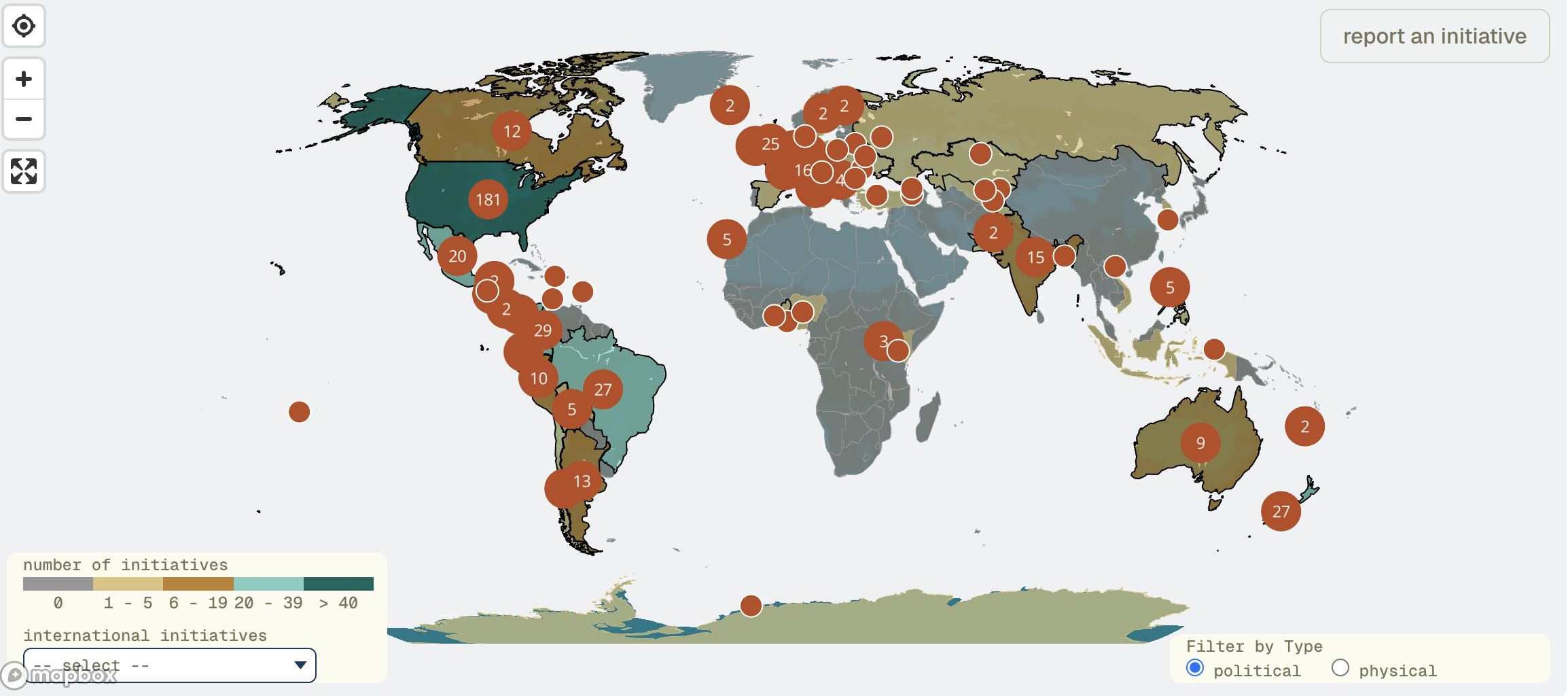
Screenshot from the Eco Jurisprudence Monitor: https://ecojurisprudence.org/
To date, the only country to recognize Rights of Nature in its national constitution is Ecuador, though Chile, Switzerland, Finland, Ireland, and Aruba have all proposed amendments to their national constitutions.[5] If passed, Aruba would become the first country in the Caribbean to recognize Rights of Nature in its constitution. Mexico has taken huge strides in recognizing the constitutional Rights of Nature, including in the states of Mexico, Guerrero, Oaxaca, and Colima, plus Mexico City.[6] Ireland has expressed a commitment to consider a Rights of Nature constitutional amendment in its COP16 Biodiversity Plan (NBSAP; see Objective One, Action No. 1C2).[7] And as of June 2026, there have been over 130 national statutory Rights of Nature laws initiated worldwide.[8]
Many Indigenous Nations in what is often known as the United States[9] and Canada[10] have also recognized Rights of Nature in their constitutions or governing law. These initiatives often codify traditional knowledge and customary laws that distinguish natural rights from rights granted by humans or Western laws. In countries that do not recognize Indigenous sovereignty, many Indigenous Peoples have issued declarations to assert their authority to recognize Rights of Nature.[11]
Marine ecosystems have become a leading frontier in the Earth law and Rights of Nature movement, with island nations drawing on Indigenous culture and local community stewardship to advance ecocentric legal frameworks. In 2024, Indigenous leaders from the Cook Islands, Tonga, Tahiti, Hawai'i, Rapanui (Easter Island), and New Zealand jointly signed the He Whakaputanga Moana (Declaration for the Ocean). The historic treaty officially declares whales (tohorā) and dolphins as legal persons with inherent rights to freely migrate, develop natural behaviors, and thrive in healthy marine ecosystems. The treaty inspired a 2026 bill in New Zealand affirming whales’ rights to migrate, maintain natural behaviors and culture, and live in a healthy environment with damaged habitats restored.[12]
Similarly, in 2016, the Loyalty Islands provincial government in New Caledonia enacted an Environmental Code recognizing the Kanak People’s cosmovision and affirming that certain elements of Nature may be recognized as a legal personality with their own rights. The Code is notable because it blends customary law, Indigenous worldviews, and French law to strengthen environmental protection.[13]
Subnationally, as of June 2026, there have been over 200 local Rights of Nature laws, provisions, or regulations initiated worldwide,[14] for example in Alto Paraguai (Brazil)[15] and Santa Monica (USA).[16]
Finally, courts are powerful forces for recognizing and enforcing Rights of Nature by interpreting existing law to justify rulings that recognize Rights of Nature, even in the absence of a national law.[17] For example, in 2015, a successful application of Ecuador’s constitutional Rights of Nature was used to defend sharks in the Galapagos Marine Reserve.[18] More recently, the Supreme Court of India recognized Rights of Nature in a 2024 ruling,[19] the Supreme Court of Bangladesh held that rivers have the status of “legal persons” in 2019,[20] and the High Court of Pakistan held that animals have legal rights in a 2020 ruling.[21]
In a landmark 2025 advisory opinion, the Inter-American Court of Human Rights (IACtHR) declared that the climate crisis has escalated into a “climate emergency” and affirmed for the first time that States have clear obligations under human rights law to confront it. The opinion also marked the first time an international court has formally recognized Nature as a subject of rights.[22]
These developments mark a profound global shift in legal thinking: from viewing Nature as property to recognizing it as a rights-bearing entity. The Rights of Nature movement is no longer a fringe idea but a rapidly expanding legal and moral framework embraced by nations, Indigenous Peoples, local governments, and courts. As climate and biodiversity crises intensify, the growing momentum for recognizing Nature's rights offers a hopeful and transformative path forward: one that redefines humanity’s relationship with the Earth and establishes a foundation for true ecological justice.

Turning Legal Rights into Living Practice
Despite many legal victories, putting the Rights of Nature into practice remains a difficult task. It requires that individuals respect Nature in their day-to-day lives, remain aware of legal developments, and shift deep-seated attitudes shaped by centuries of human-centered thinking. While legal recognition of Nature’s rights is a critical top-down step, education and cultural implementation from the ground up are equally essential.
In jurisdictions where Nature’s rights have been formally recognized in law—whether in a constitution, legislation, or court ruling—there is now an opportunity to ensure that everyone within the country, including tourists, understands and upholds these rights. Many visitors travel specifically to experience Nature’s beauty but may lack an understanding of the ecosystems they’re entering or the legal protections now in place.
To support the full implementation of the Rights of Nature, Earth Law Center proposes that national governments adopt programs that require or strongly encourage tourists to acknowledge and respect these rights when entering the country. Such programs would foster mindfulness and a cultural shift toward viewing Nature as a legal subject deserving of dignity and respect, just as we expect respectful behavior toward fellow humans when traveling abroad.

Regenerative Tourism Everywhere
The following initiatives could be adapted to the context of any Rights of Nature country:

Airport signage or displays introducing the Rights of Nature, and the human right to a clean, healthy and sustainable environment, including key quotes from national laws or constitutions that enshrine these rights.
A short educational video about the country’s Rights of Nature framework, required viewing before or upon entry. A checkbox or waiver could confirm completion.
A signed acknowledgment or waiver confirming that visitors will uphold Nature’s rights during their stay. This could be distributed via traveler cards handed out on airplanes, integrated into visa applications, or included with customs declarations.
A symbolic passport stamp or separate entry slip that recognizes the country’s legal commitment to Nature’s rights. Some countries issue a separate paper slip in place of a physical stamp; this could be adapted to highlight that Nature has granted symbolic entry approval. Palau is a great example: the “Palau Pledge,” written as a poem, reads “I vow to tread lightly, act kindly, and explore mindfully.”
Informational brochures, guides—or even an app—provided during transit or at arrival, explaining Nature’s legal status and how tourists can minimize their impact and support local conservation.
Donation boxes placed at arrival terminals, with signage explaining the Rights of Nature and how contributions support the enforcement and restoration of natural ecosystems.
An optional online quiz for incoming tourists to test their understanding of local ecosystems and how to uphold the Rights of Nature. Incentives such as small discounts on eco-tours, transport, or lodging could encourage participation.
Video projections in immigration or baggage claim areas explaining the legal and cultural importance of Nature’s rights and tourists’ role in honoring them.
Local art installations in transit spaces that celebrate biodiversity and communicate the spirit of the Rights of Nature movement.
Touch-screen kiosks in arrival halls where visitors can explore information about the country’s ecosystems, rights-based legal protections, and tips for respectful travel.
Nature-based activities and workshops for tourists, such as tree planting, wildlife monitoring, or hands-on restoration projects, plus opportunities to learn from local conservation leaders and Rights of Nature advocates.
Promoting Indigenous and local communities and businesses (e.g., “Think Global, Shop Local”).
Follow the example of Bhutan, which has a unique sustainable approach of “High Value, Low Volume” tourism to ensure conscious tourism sector growth.
Regenerative Tourism for Islands and Coasts
With millions of people drawn each year to island, coastal, and tropical environments, and with marine ecosystems at the forefront of the Earth law and Rights of Nature movement, there is a unique opportunity to strengthen protections of these amazing and critical ecosystems through several targeted additions.

A prominent display of the Rights of Nature constitutional provision, national law, or local ordinance in the airport, with copies provided to businesses and citizens to display proudly.
On destination flights, play a video about the importance of respecting cultural heritage and preserving the country’s ecosystems and species (don’t take anything, don’t leave trash, respect and don’t interfere with animals, plants, etc. on the island). Air New Zealand provides a great example.[23]
Tools and training for citizens to empower them and educate visitors on how to respect and comply with the Rights of Nature, and other protective environmental laws, culture, and ethics of the island.
Information about coral reefs, coral reef bleaching, and rights for deep sea organisms explained to tourists at snorkeling rental facilities and resorts (encouraging tourists to be respectful of these organisms while snorkeling). Earth Law Center has a Coral Reefs Toolkit,[24] as well as a Declaration of Rights for Deep Sea Species and Ecosystems,[25] available to use. The Coral Reefs Toolkit provides an in-depth guide for policymakers, advocates, and legal professionals to follow, including model legislation.
Education about ecocentric, low-impact ways to enjoy the island for its intrinsic value, especially its places of high biodiversity importance and culture (such as coral-reef surveys and beach cleanups; learning about deep-sea species and ecosystems; visiting and supporting animal sanctuaries).
Mock-Ups
Sample language for a waiver of acknowledgement (to be included in a passport traveler card, customs card, or visa application):
As a traveler to [Country], I acknowledge that the country has granted legal rights to Nature, recognizing it as a living entity with its own inherent value and rights. I understand that these rights are enshrined in law and are intended to protect natural ecosystems and biodiversity from degradation and exploitation. I agree to respect and uphold the Rights of Nature during my stay in [Country], and to refrain from any actions that may harm or violate these rights. By signing this waiver, I express my consent and appreciation for the Rights of Nature in [Country], and I pledge to be a responsible and respectful visitor.
Passport Stamp Design
There are any number of possible designs for a passport stamp, showing that Nature has granted entry to a traveler, based on an understanding the traveler will uphold the Rights of Nature. It could include phrases like “Ingressus a Natura Concessus” (Latin for “granted entry by Nature”) or “Iura Naturae Reverere” (Latin for “respect Nature’s rights”). Or similar culturally resonant designs for a given country.

Next Steps & Conclusion
To implement these ideas effectively, we encourage governments and institutions to reach out to Earth Law Center (ELC). Our team of experienced lawyers and affiliated artists can provide tailored consultation, help design impactful educational materials, and ensure that any initiatives align with the spirit and legal framework of the Rights of Nature. From legal language to visual storytelling, ELC can help co-create programs that both inspire and comply with best practices in ecocentric law.
The Rights of Nature framework fundamentally transforms how human society views and treats the natural world. By recognizing Nature’s legal right to exist, thrive, and evolve, it places ecological protection at the core of environmental governance. While countries like Panama have taken bold steps by enshrining these rights into law, ensuring they are respected in practice is essential to their success. Local populations may already be familiar with these laws, but tourists—many of whom come from countries where such concepts are still unfamiliar—require additional guidance. Mandating initiatives that help tourists understand and comply with Rights of Nature laws represents a powerful next step in realizing the full potential of these legal protections.
Notes
[1] Sid Perkins, Tourism Is Four Times Worse for the Planet Than Previously Believed, Science (May 7, 2018), https://www.science.org/content/article/tourism-four-times-worse-planet-previously-believed
[2] See Eco Jurisprudence Monitor, Initiatives Index: Navajo Nation Code Recognizing the Rights of Nature , https://ecojurisprudence.org/initiatives/navajo-nation-code/ (last visited June 15, 2026). Eco Jurisprudence Monitor information is constantly updated. We wish to thank the Eco Jurisprudence Monitor for providing the data on ecological jurisprudence initiatives used in this paper. The Eco Jurisprudence Monitor was created through collaboration among an international team of independent researchers affiliated with the Academic Hub of the Global Alliance for the Rights of Nature. The project was funded by the Rockefeller Brothers Fund.
[3] See Tamaqua Borough, Pa., Ordinance No. 612, Tamaqua Borough Sewage Sludge Ordinance (Sept. 19, 2006), https://ecojurisprudence.org/wp-content/uploads/2022/02/US_Tamaqua-Borough_-Tamaqua-Borough-Sewage-Sludge-Ordinance_2.pdf
[4] Eco Jurisprudence Monitor, Initiatives Index: Rights of Nature, https://ecojurisprudence.org/?post_type=ejm_initiative&_ejm_eco_jurisprudence=rights-of-nature (last visited June 15, 2026).
[5] Chile’s constitutional amendment was brought to the Constitutional Convention in 2022 but did not pass. Switzerland, Aruba, Ireland, and Finland’s constitutional amendments are all pending approval.
[6] Eco Jurisprudence Monitor, Initiative Index: Rights of Nature Initiatives in Mexico, https://ecojurisprudence.org/?post_type=ejm_initiative&_ejm_eco_jurisprudence=rights-of-nature&_ejm_country=mx (last visited June 15, 2026).
[7] Ireland, National Biodiversity Strategy and Action Plan (v.4) (2024), Convention on Biological Diversity, https://www.cbd.int/doc/world/ie/ie-nbsap-v4-en.pdf
[8] Eco Jurisprudence Monitor, Initiatives Index: Rights of Nature - National Level, https://ecojurisprudence.org/?post_type=ejm_initiative&_ejm_eco_jurisprudence=rights-of-nature&_ejm_gov_level=national (last visited June 19, 2026).
[9] Including the Ho-Chunk Nation, the Menominee Tribe, the Navajo Nation, the Nez Perce Tribe, the Ponca Nation, the Tohono O'odham Nation, the White Earth Band of Ojibwe, and the Yurok Tribe.
[10] Including the Esdilagh First Nation and the Innus of Ekuanitshit.
[11] See Traditional Owners of the Fitzroy River Catchment, Fitzroy River Declaration (Nov. 2016), https://static1.squarespace.com/static/59fecece017db2ab70aa1874/t/5b286f2bf950b776fe5ead56/1529376561505/Fitzroy+River+Declaration._2016.pdf. See also Eco Jurisprudence Monitor, Declaration for the Protection of the Amazon Sacred Headwaters, https://ecojurisprudence.org/initiatives/amazon-sacred-headwaters-initiative-declaration-for-the-protection-of-the-amazon-sacred-headwaters/ (last visited June 22, 2026).
[12] Rob Hutchins, A Law for the Tohorā: New Zealand Bill Seeks Personhood for Whales, Oceanographic (Feb. 11, 2026), https://oceanographicmagazine.com/news/new-zealand-bill-seeks-personhood-for-whales/
[13] Eco Jurisprudence Monitor, Loyalty Islands Province Environmental Code 2023: Rights of Sharks and Sea Turtles, https://ecojurisprudence.org/initiatives/new-caledonia-law-on-sharks-and-sea-turtles-as-natural-entities/ (last visited June 21, 2026).
[14] Eco Jurisprudence Monitor, Initiative Index: Local Rights of Nature Initiatives, https://ecojurisprudence.org/?post_type=ejm_initiative&_ejm_eco_jurisprudence=rights-of-nature&_ejm_gov_level=local (last visited June 15, 2026).
[15] See Eco Jurisprudence Monitor, Alto Paraguai (Brazil) Municipal Organic Law: Rights of Nature, https://ecojurisprudence.org/initiatives/municipality-of-alto-paraguai-brazil-municipal-organic-law-amendment-recognizing-the-rights-of-nature-and-harmony-with-nature/ (last visited June 18, 2026).
[16] See Eco Jurisprudence Monitor, Santa Monica (USA) City Ordinance: Groundwater Sustainability (2018), https://ecojurisprudence.org/initiatives/santa-monica-ordinance-sustainable-groundwater-ordinance/ (last visited June 18, 2026).
[17] As of June 2026, the Eco Jurisprudence Monitor identifies over 140 Rights of Nature court cases or rulings worldwide. Eco Jurisprudence Monitor, Initiative Index: Rights of Nature Court Cases, https://ecojurisprudence.org/?post_type=ejm_initiative&_ejm_eco_jurisprudence=rights-of-nature&_ejm_legal_provision=court_case (last visited June 18, 2026).
[18] Shelia Hu & Michelle Bender, Rights of Nature to Save the Endangered Sharks of the Galapagos, Earth Law Ctr. (July 9, 2018), https://www.earthlawcenter.org/blog-entries/2018/7/rights-of-nature-to-save-the-endangered-sharks-of-the-galapagos
[19] See State of Telangana v. Mohd. Abdul Qasim, 2024 INSC 310 (India).
[20] Eco Jurisprudence Monitor (EJM), Bangladesh Court Case: Rights of the Turag River, https://ecojurisprudence.org/initiatives/rights-of-rivers-in-bangladesh/ (last visited June 22, 2026).
[21] See Islamabad Wildlife Mgmt. Board v. Metro. Corp. Islamabad, W.P. No.1155/2019, Judgment, Islamabad High Ct. (2020).
[22] Aitana Rosas Linhard and Earth Law Center, In Landmark Opinion, Inter-American Court of Human Rights Recognizes Rights of Nature for the First Time, Earth Law Ctr. (Aug. 4, 2025), https://www.earthlawcenter.org/blog-entries/2025/8/in-landmark-opinion-inter-american-court-of-human-rights-recognizes-rights-of-nature-for-the-first-time
[23] Esther Faith Lew, Air New Zealand Weaves in Māori Magic to Address Sustainable Tourism, Little Black Book (Aug. 9, 2022), https://lbbonline.com/news/air-new-zealand-weaves-in-maori-magic-to-address-sustainable-tourism
[24] Earth Law Center, Rights of Coral Reefs, https://www.earthlawcenter.org/coralreefs (last visited June 18, 2026).
[25] Earth Law Center, Rights of the Deep Sea, https://www.earthlawcenter.org/deepsea (last visited June 18, 2026).