
Can Ukraine Charge Russia With Ecocide?
By Robert Moser
When Vasly, a Ukrainian citizen living in the Russian-occupied city of Hola Prystan, awoke on the morning of June 6, 2023, he got out of bed to the sound of rushing water. Heading downstairs, he discovered that the entire first floor of his building was under water. In the pre-dawn hours, Russian saboteurs had destroyed the Kakhovka Dam, a large levee sixty miles upstream from Hola Prystan. The water from one of the world’s largest reservoirs, normally held back by the dam, rushed downstream, destroying miles of the Ukrainian river valley and displacing thousands of residents. The dam’s sudden demise will impact fragile ecosystems for decades to come.

Settlements on the left bank of Dnieper River underwater after the Kakhovka Dam was breached on June 6, 2023. Photo credit: АрміяInform, CC BY 4.0, Wikimedia Commons.
The destruction of Kakhovka Dam stands apart from normal military operations. The dam had changed hands between Ukrainian and Russian forces several times during the war, and the above-water sections bore visible scars from the fighting. For Russia to render the dam inoperable, it could seize and hold the infrastructure with troops, damage the turbines or other visible components, or sabotage the electrical components that carry hydroelectric power away from the dam. What Russia chose to do was much more catastrophic: detonate a large explosive in the solid concrete base of the structure, well below the waterline. This ensured the complete destruction of the dam and the release of the large reservoir, threatening the lives of humans and the destruction of the environment.
The destruction Kakhovka Dam is at the center of a growing push to charge Russia with crimes related to the devastation of Ukrainian ecosystems during its invasion. While there are various international legal conventions that seek to limit environmental destruction during wartime, the Ukrainian situation is of a different kind rather than degree. Legal experts have argued that Russia’s actions reach the level of ecocide—a theoretical crime never before charged or tried by the International Criminal Court (ICC) in the Netherlands.
Environmental and Ecological Destruction in Ukraine
The Ukrainian landscape has endured a level of destruction not seen in Europe since the World Wars. While the destruction of cities has been extensive (nearly 210,000 buildings have been destroyed according to an analysis by the New York Times), Ukrainians have argued that Russia has also intentionally targeted farms, forests, and other natural bodies in a deliberate attempt to render the land uninhabitable. Ukraine’s Ministry of Economy, Environment and Agriculture has compiled a database of 10,668 eco-crimes, estimating the environmental damages of the war at a staggering 136 billion euros.
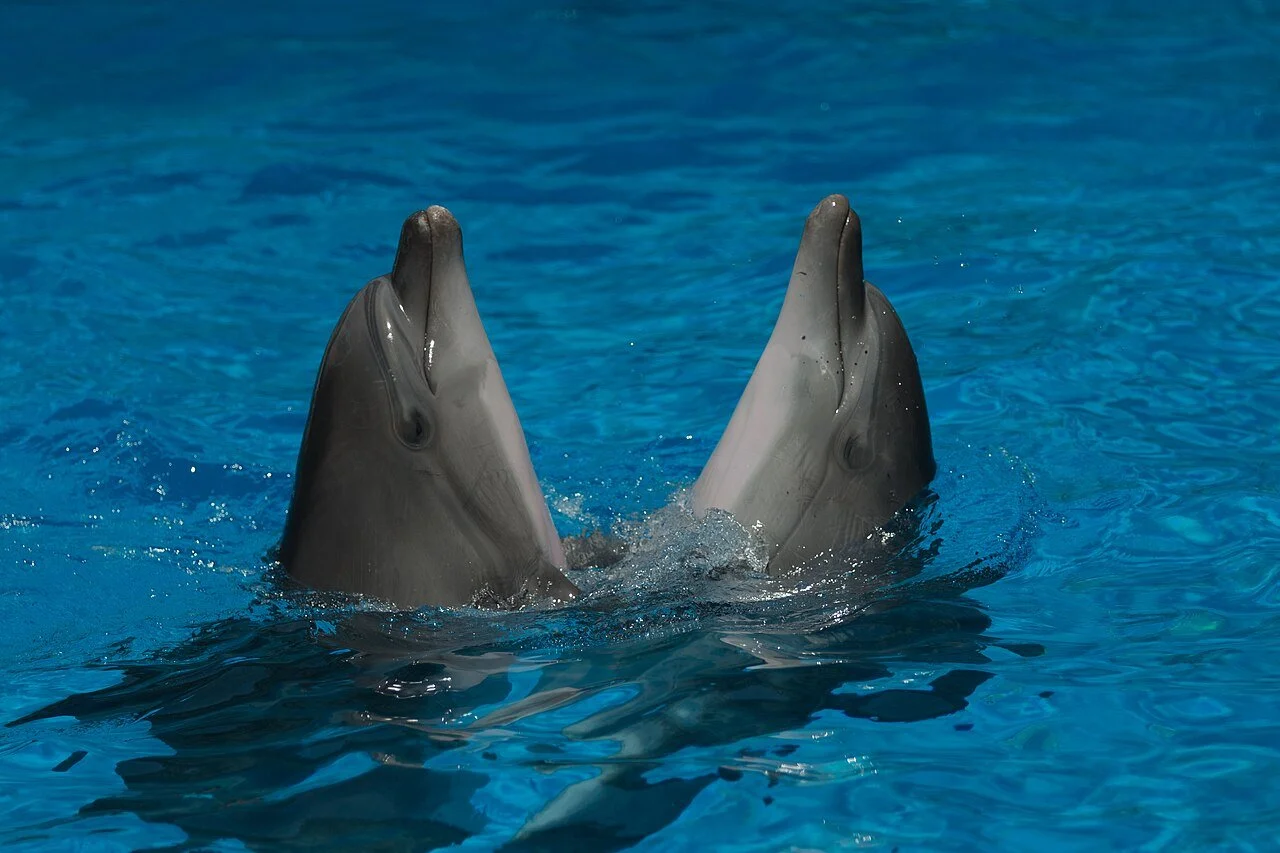
Two Black Sea dolphins. Photo credit: Роман Дергунов, CC BY-SA 4.0, Wikimedia Commons.
Of course, this is only the monetary cost to humans; many of the other living populations killed or displaced by the war will never recover. For example, in June 2026, Russian naval operations killed more than forty dolphins on the Odesa coastline—adding to a likely toll of tens of thousands of Black Sea dolphins killed by the war. While the deaths of dolphins is of marginal economic value to humans, it represents a profound loss to the marine populations and ecosystems in the area. The true scale of destruction to the natural world will likely never be known.
As Anna Kuzemko, a Ukrainian biological sciences researcher, explains, “War destroys nature comprehensively. Trenches and fortifications change the landscape, disrupt the soil cover, and destroy plants and animals. The problem is that we don't yet have a single methodology capable of assessing the entire range of destruction."
To make matters worse, the figures of environmental destruction cited in official reports are almost certainly undercounts, as Ukrainian officials are unable to document effects in Russian-occupied territory or in areas made inaccessible by active hostilities. Roughly 19% of Ukrainian territory remains under Russian occupation, so official figures should be understood as absolute minimum values of the true scale of environmental destruction.
This destruction threatens far more than individual Ukrainians displaced by floodwaters or starved by crop destruction. The Washington Post declared, “Russia’s war in Ukraine is a ‘watershed moment’ for [the] climate crisis.”
Political leaders often focus on the immediate impacts to humans, like the impact to global grain markets and oil markets, and urge their countries to stimulate domestic energy production or accelerate the transition to renewable fuels to reduce dependence on foreign oil. But there are less obvious concerns with ecological destruction—for example, water insecurity, carbon dioxide emissions from military vehicles, and the destruction of carbon sequestering ecosystems—that will have a much more serious impact on the global climate.
One aspect of the war that rarely gets mentioned is the threat that hostilities pose to biodiversity. Several species endemic to the combat zone are listed on the International Union for the Conservation of Nature (IUCN) Red List as either endangered or critically endangered. The loss of these unique species and habitats, along with the loss of human life, is one of the truly irreversible consequences of war. Agriculture can eventually be restored and buildings rebuilt. However, species extinction and ecosystem destruction are permanent.
Movement Toward Ecocide in National and International Law
War has always harmed the environment. But as our understanding grows of the interconnectedness of Earth’s ecosystem and the immediate peril of climate change, a community of international experts has begun to push for the criminalization of the destruction of nature per se rather than only as it affects humans. This requires a subtle mindset shift in the international legal world—could nature be protected for its own intrinsic value, irrespective of its relative value to humans?
The answer to this question, once an emphatic no, is beginning to shift. Activists and academics have long called to protect the environment in war time. The idea of ecocide has been around since at least the Vietnam War, when various scholars accused the United States of committing ecocide during Operation Ranch Hand—the military defoliation campaign that resulted in millions of gallons of Agent Orange and other pesticides dropped on the Vietnamese countryside. Their calls fell on deaf ears. The international legal system enacted after World War II had little interest in expanding its jurisdiction and interests from the human community to a broader ecological community. And the major players in the international system, including the United States, had a vested interest in keeping those international frameworks as hamstrung as possible. Until recently, the rhetoric to expand international criminal jurisdiction to cover crimes against the environment was just that—rhetoric.
The Ukrainian War, however, has shifted the movement to codify ecocide into international law into high gear.
In 2021, an independent panel of international legal and environmental experts convened to define a new international crime:
“ecocide means unlawful or wanton acts committed with knowledge that there is a substantial likelihood of severe and either widespread or long-term damage to the environment being caused by those acts.”
Ukrainian leaders have accused Russia of ecocide: President Zelensky himself called the destruction of Kakhovka Dam “an environmental bomb of mass destruction.” Ukraine even has a national law, Article 441 of the Ukrainian criminal code, that criminalizes ecocide as the “mass destruction of flora and fauna, poisoning of air or water resources, and also any other actions that may cause an environmental disaster” that is “punishable by imprisonment for a term of eight to fifteen years.”
As the world continues to experience climate catastrophes of an unprecedented scale, the push to criminalize ecocide in many jurisdictions has picked up steam.
In April 2026, Mauritius became the latest state, out of a total of at least fifteen, to pass a law criminalizing ecocide. The European Union revised its Environmental Crime Directive to require states to pass ecocide-like laws (France and Belgium led the way in 2021 and 2024, respectively).
Push to Incorporate Ecocide in the Rome Statute
The Rome Statute and the ICC are primarily concerned with jurisdiction over armed hostilities, and, in the Ukrainian context, the focus is on wartime ecocide. Proponents of ecocide laws advocate for it to be considered a crime in peacetime as well as wartime.
Before the international community can charge Russia (or any country) with committing ecocide in wartime or peacetime, however, it must first officially declare ecocide to be a crime. The International Court of Justice (ICJ), where wartime disputes between countries are litigated, has shown an increased willingness to investigate harms to the environment but has so far neglected to officially extend its jurisdiction to cover ecocide. The ICC, created by the Rome Statute in 1998, hears cases of war crimes brought against individuals.
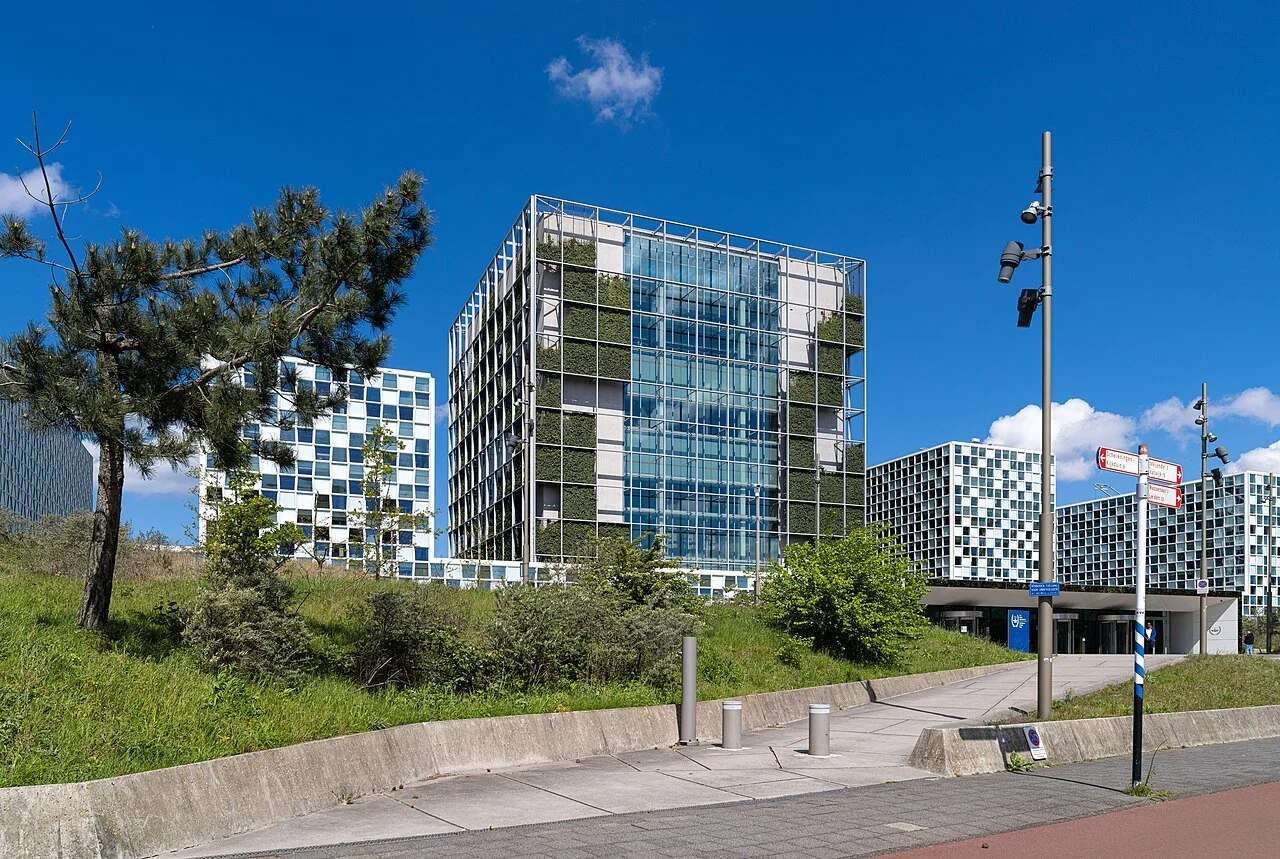
The International Criminal Court in The Hague, Netherlands. Photo credit: Thomas Wolf, www.foto-tw.de, CC BY-SA 3.0 DE, via Wikimedia Commons.
The Rome Statute gives the court jurisdiction over individuals accused of four international crimes that the global community has determined especially heinous:
genocide
crimes against humanity
war crimes
crimes of aggression
Pacific nations like Fiji and Vanuatu, with help from renowned legal activists, are leading the push at the UN to officially expand the Rome Statute to make ecocide the fifth crime under its jurisdiction. In 2024, Vanuatu formally submitted a proposal to amend the Rome Statute to include a fifth international crime of ecocide.
Unfortunately, the international system is still quite resistant to change. While small island nations unfairly lack the presence at the UN to exert considerable influence, large European nations like Ukraine can be central to implementing this legal development.
Importantly, the ICC has jurisdiction over individuals accused of the aforementioned crimes; the separate ICJ has jurisdiction over disputes between states. Countries often struggle to enforce environmental protections due to the transboundary dimension of many climate disasters, which makes the ICJ the best arbiter of such issues.
Even though Ukraine has its national law criminalizing ecocide, Article 441, it remains weak and ineffective in holding foreign actors accountable. Currently, law enforcement officials in the Kharkiv region are investigating two cases of ecocide under Article 441, but while Ukraine could theoretically charge individual Russians like Vladimir Putin with violating such an article, it lacks the extradition or enforcement powers over a head of state. It would be forced to try individual Russians in absentia, and could not try the state of Russia at all.
What Can Ukraine do?
After World War II, the international community came together to define a new set of global norms that transformed the moral conversation across the world. It can do so again.
Ukraine must continue to be a vocal proponent of the criminalization of ecocide against Russia, holding it responsible not only for crimes against humanity but for crimes against the Earth as well. Ukraine has done a tremendous job on this front and has largely succeeded in getting ecocide into the United Nations conversation in the last few years. It achieved a significant win in 2025 at the IUCN World Conservation Cоngress, in which the unofficial Ukrainian delegation (Ukraine is not formally a party to the IUCN) pushed through a resolution on the mechanisms for working with IUCN members involved in armed conflicts. It thus opened the path for an IUCN-recognized Green List in Ukraine, among other achievements. For the first time, the issue of the environmental consequences of the war in Ukraine was raised at an IUCN World Congress.
Ukraine’s current ecocide statute is underdeveloped and ill-defined—it is up to Ukrainian activists and lawyers to flesh out a jurisprudence of ecocide that could be implemented and exported to other countries. Ongoing investigations into ecocide are an encouraging sign that Ukrainian prosecutors take such laws seriously; trials and convictions would further bolster political support for an international ecocide law.
Lastly, legal scholars across the world need to deepen both our understanding of and commitment to preventing wartime and peacetime ecocide. There has been scant coverage of per se crimes against nature in US legal scholarship; as one of the five permanent members on the UN Security Council, the United States and its representatives must commit themselves to holding Russia accountable for its crimes.
Ukraine is showing us the way out of the joint crises of climate and military aggression. The rest of the world needs to listen.