
Health Equity and Ecocentrism: A Literature Review

By Ariel Zedric, with support from Aisha O’Neil
With support from the Robert Wood Johnson Foundation, Earth Law Center (ELC) has for the past several years worked on projects exploring health equity and ecocentrism. Deep connections exist between environmental law and equitable outcomes in human population health. Deteriorating ecological factors (such as water contamination and pollution) lead to worsening human wellness. Conversely, a healthy relationship between society and Nature greatly benefits human health.
Bernard Abraham, President of Weskit-Chi Aboriginal Trappers Association (a Canadian Indigenous organization), described the traditional relationship between Aboriginal people and the land in this way: the forest was “their food bank, drugstore, meat market, bakery, fruit and vegetable stand, building material centre, beverage supply, and the habitat for all of the creator’s creatures” [1]. The human population as a whole has grown far beyond the point where such a total connection between wild Nature and human health remains possible, yet physical, mental, and social ailments are now pushing human societies around the globe to consider how reconnecting with Nature could improve health outcomes and health equity.
In this article, we detail the birth of the term “health equality/equity,” look at social and ecological determinants of health, consider certain Indigenous perspectives on health and health equity, and propose an ecocentric approach to the study of health.
The Birth of Health Equity
The term “health equality” has been traced to the 1966 article “Equality and Health.” Considered the first published health equity study, it focused on medical discrimination against Black Americans in medical facilities and the failure of the legal system to address it [2]. This was, however, far from the first work examining the issues that are today gathered under the term “health equity.”
As far back as 1842, a study identified variations in mortality associated with social class [3]. The German philosopher Friedrich Engels, best-known for his collaborations with Karl Marx, identified worse health outcomes for industrial workers with low incomes in 1845.
By 1946, the World Health Organization accepted that health was broader than mere physical health and instead was a “state of complete physical, mental, and social well-being and not merely the absence of disease or infirmity.”

Sir Michael Marmot helped introduce the term “social determinants of health.” Photo credit: John Sears, CC BY-SA 4.0, via Wikimedia Commons.
Social Determinants of Health
In 1973, researchers identified a broad spectrum of social and economic factors associated with higher risks of dying and lower life expectancy. These include age, sex, education, income, occupation, race, marital status, parity (number live births a woman has), nativity (place of birth), socioeconomic status, and geographic classifications. A 1999 book outlined the influence of a variety of social factors on health and seems to have introduced the term “social determinants of health” into the mainstream [4]. The literature from this point forward unanimously supports the finding that social factors influence health outcomes.
From that finding came the inevitable conclusion that action must be taken to address health inequity and that, while ensuring immediate wellbeing is optimal, any such action must root out structural inequity as well [5]. Such action furthermore requires changes across numerous levels of social structure and social policy, not merely health bodies.
Ecological Determinants of Health
People have drawn connections between ecology and health since the dawn of medicine, connecting various environmental factors (e.g., contaminated water, polluted air, bacteria) to poor physical health in humans. The various ecological processes and natural resources essential to the health and well-being of humans—such as oxygen, water, food, the ozone layer, fresh soil, materials for shelter, and so on—have been called “ecological determinants of health” [6].
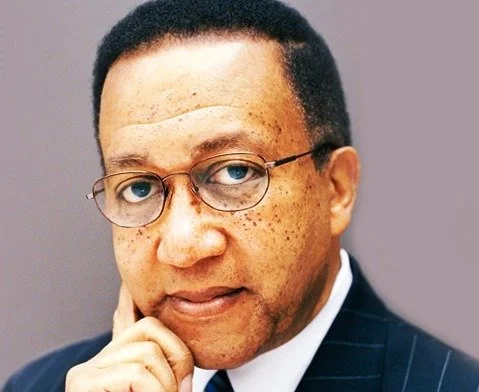
Dr. Benjamin F. Chavis, Jr., who coined the term “environmental racism” in the 1980s and was a founder of the environmental justice movement. Photo credit: MeetDrBen, CC BY-SA 3.0, via Wikimedia Commons.
In the mid-1980s, Dr. Benjamin Chavis, a preeminent civil rights leader and author, coined the term “environmental racism,” noting that the harshest impacts of environmental hazards and pollution were experienced by marginalized communities [7]. As climate change became a progressively more urgent matter, its greatest harms were also determined along social lines [8]. The reality of environmental racism blurs the line between social and ecological determinants of health.
Later articles began to discuss the systemic connections between climate change, social inequities, and health. For example, a 2014 paper argued:
“powerful institutions (eg. government, corporations, schools) are largely responsible for constructing systems (for instance, transportation, land use, food and agriculture, energy, economic) that shape living conditions. These institutions both influence and are influenced by social inequalities, such as class and race. The same systems that determine living conditions are also key contributors to climate change, and to other extensive ecosystems damage (eg. soil degradation, air pollution, water contamination, ocean dead zones.” [9]
Work such as this integrates environmental determinants with social determinants of health. Rather than viewing the two as separate, the literature began to acknowledge their interconnectedness and the imperative of addressing both together.
Researchers accordingly began to explore more holistic approaches that integrate biological, material, social, and cultural aspects, and that emphasize interconnectedness of ecosystems and human health. Concretely, this means overhauling public health systems to expand beyond individualistic approaches. Rather than focusing on individual behaviors, that is, the public health system must coordinate across local, national, and global levels to integrate environmental determinants of health into its framework. This includes engaging with large transitions like urbanization and climate change rather than focusing only on short-term, genetic and behavior-based factors in human health [10].
This approach uses the word “ecology” more broadly than in the sense most typical to academic or field ecology, in which it is closely tied to the functioning of particular ecosystems. It is instead an approach that learns from the interconnectedness of natural systems and acknowledges the same interconnectedness in human systems and between human and natural systems.
Indigenous Perspectives on Health
In discussing the acknowledgment of ecological and social determinants of health, and their interconnection, in Western conceptions of public health, it is important to recognize that many Indigenous Peoples and nations have maintained culturally nuanced, holistic conceptions of health. Additionally, it must be recognized that Indigenous cultures differ vastly. The perspectives on health that are discussed here are, therefore, specific to the peoples named [11].
The 2007 International Study on Indigenous Perspectives on Health surveyed several nations’ views on health. It notes that all the surveyed communities conceived of health as relationship to community and environment, both physical and spiritual, and not as the absence of disease. Gaspar Castro, a K’iché man, described well-being as “being well in the family, being well in the home . . . it means not suffering hunger, not suffering illness, not suffering in your thinking either, because if you’re bad in your mind, that means not living well.”
Across the peoples interviewed, family and community were deeply linked to environmental and spiritual factors that influence health and wellbeing. The study discusses the “crucial importance and significance of land” as the root of livelihood, language, society, culture, governance, legends, beliefs, and more [12].
In her paper on the Indigenous Peoples of the Chiapas region of Mexico, Proochista Ariana, a professor at Oxford University, notes that Indigenous concepts of health can be vastly different from norms that ground global health interventions. To address health in some Indigenous communities thus requires a different approach.
Prior to colonization, Mayan peoples viewed health as linked with cosmology and their broader worldview, tied to the struggle between good and evil. Good health was seen as the standard, and ill health as a deviation caused by supernatural interferences. Good health thus required “harmony with the expectations of his society and . . . peace with others.” Social balance or imbalance is therefore central to this perspective. Some Mayan social expectations include respect for elders, for tradition, and for the environment. Modern Indigenous Peoples in the area define health as peace, happiness, and absence of social problems, as well as freedom from disease. Many center “being well” in family and community, harmony, and producing food. Far from being a mere resource, land is considered a primary source of life that nourishes and supports health [13].
To take a different example, the Plains Cree perspective reveals a similarly holistic understanding of health that incorporates concepts of harmony and balance—per the teachings of the Medicine Wheel—with self, community, and the natural world [14].
A 2019 article comparing a number of Indigenous perspectives of wellbeing explores the connections between self, community, and land in notions of wellbeing amongst the peoples studied. All three, it claims, are understood as one, fundamentally entwined and often inseparable. Affecting one affects the others. In terms of Nature, all aspects of land are seen as having intrinsic value and deep spiritual power. The spiritual relationship between many Indigenous Peoples and their lands is the foundation of cultural and individual identity, with knowledge of land and knowledge of self deeply related [15].
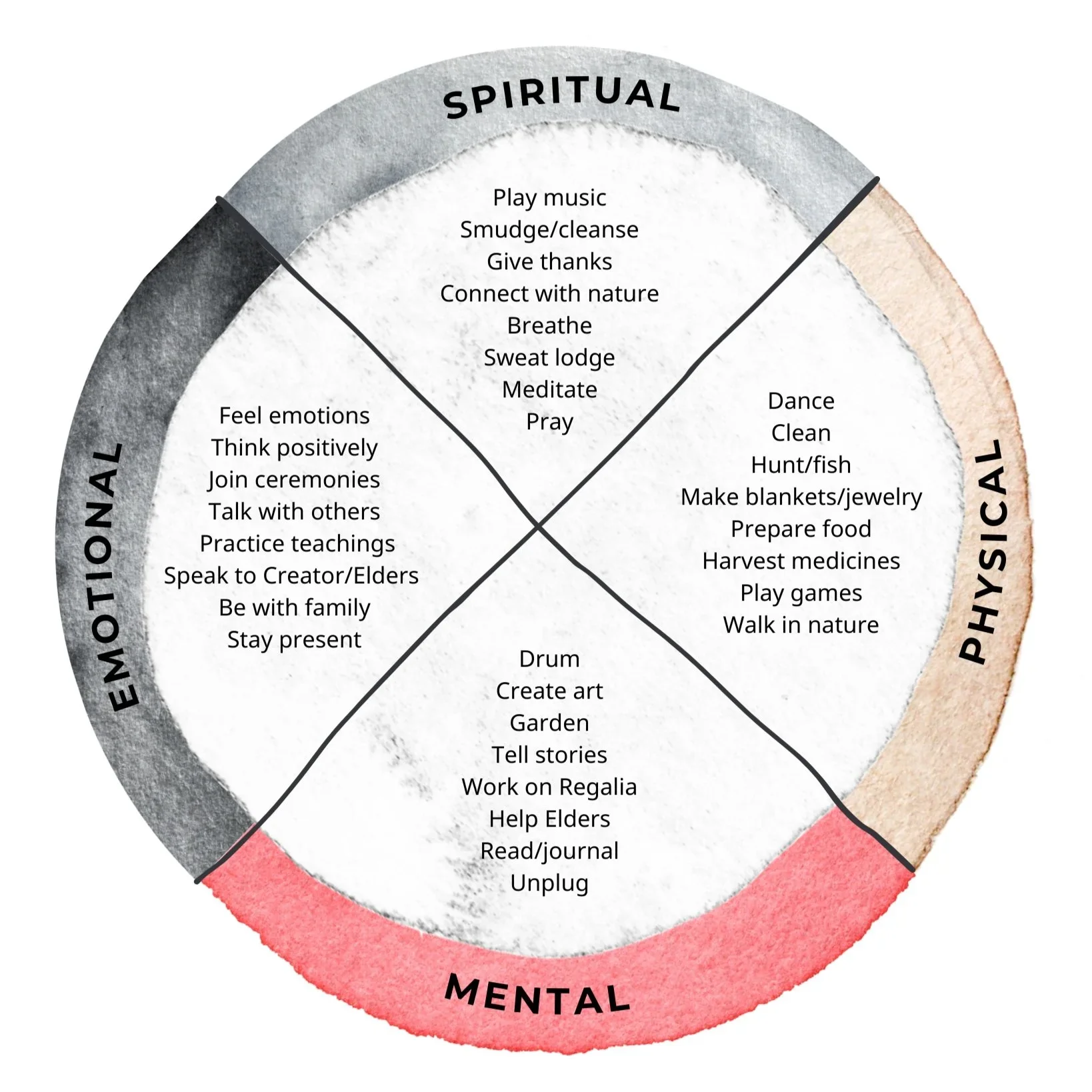
From “Acknowledging the Weight of September” by Indian Residential School Survivors Society
An Ecocentric Approach to Health
Promoting health equity requires a holistic approach that addresses systemic inequalities and environmental injustices. Nature and humanity are inextricably linked. We rely on each other for health and wellbeing: human wellbeing depends on a healthy environment, while Nature’s wellbeing depends on human activity. Indeed, human wellbeing depends on the availability of natural resources, and beyond that, it is supported by the mere presence of Nature in our lives [16].
An anthropocentric view of the ecological determinants of health thinks only of the services that Nature can provide to humans. It fails to recognize the cyclical relationship between humans and the natural world, and our interreliance. This approach lends itself too readily to over-exploitation of natural resources and unsustainable practices. Conserving Nature only for human purposes also risks inadequate protection and care for other living beings that depend on us, just as we depend on them [17].
An ecocentric perspective enables the health and wellbeing of all by never asserting that only humans have intrinsic value. Ecocentrism is a sustainable, future-focused approach.
Given the unequal distribution of environmental harms, an ecocentric view of health equity must not elide the concerns of particular peoples. Marginalized people face significantly greater environmental harms and should not be further burdened in the name of protecting or promoting Nature. Nor should their voices be overridden by the privileged in conservation and protection efforts. Those affected are best suited to determine what is needed to ensure mutual, sustainable wellbeing and health for themselves, their communities, and the natural world that surrounds them.
Earth Law Center has advocated for an ecocentric perspective on Nature since its inception in 2008. It advances this perspective by incorporating Rights of Nature, natural personhood, and guardianship into international law and local laws across the world.
For example, in March 2024, in a case supported by ELC and partners, Kukama Indigenous women were appointed the legal guardians of the Marañón River as part of the outcome of a lawsuit they brought to a Peruvian court [18]. The decision adopts an ecocentric perspective by acknowledging the river’s rights while also recognizing the importance of the river to the Kukama and the effects that the threats to the river’s health have on the Indigenous Peoples that live with and around it. The work to enshrine Rights of Nature in law is therefore a concrete mechanism through which health, equity, and justice can be achieved.
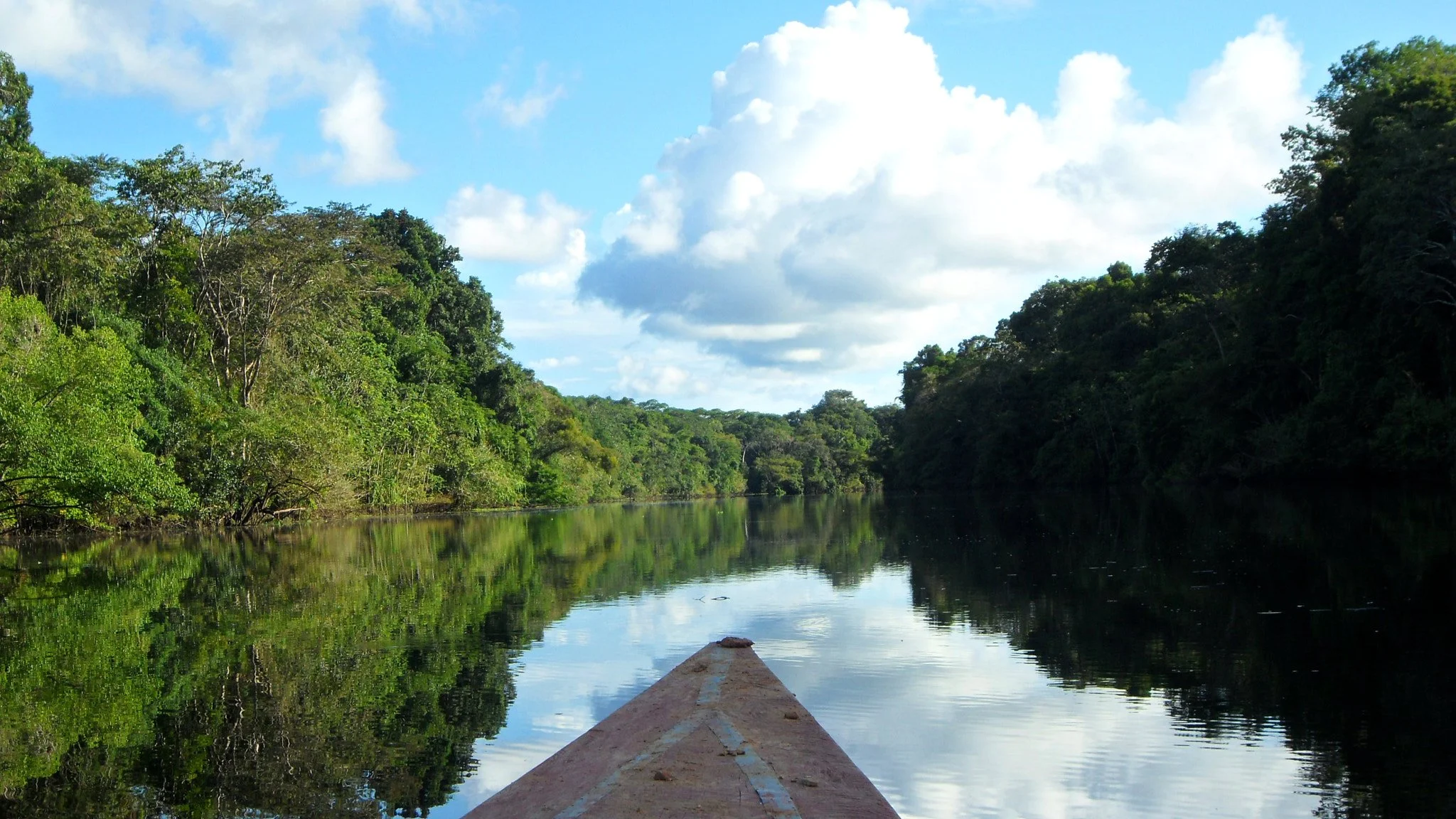
Pacaya Samiria Marañon River, creative commons license
Health Equity Discourse: A Timeline
1842: Sir Edwin Chadwick’s study identifies variations in mortality based on social class
1845: Friedrich Engels identifies worse health outcomes for industrial workers
1946: WHO accepts a broader definition of health
1966: Michael Meltsner coins the term “health equity”
1973: Evelyn Kitagawa and Philip Houser identify broad spectrum of socioeconomic factors related to health
1982: Dr. Benjamin Chavis coins the term “environmental racism”
1999: A book by Michael Marmot and Richard Wilkinson outlines the influence of social factors on health
2007: The International Study on Indigenous Perspectives on Health notes that all surveyed communities conceive of health as a relationship
2012: Tim Land and Geof Rayner’s paper explores an ecological approach to public health
2019: Monica Yadeun-Antuñano examines connections between self, community, and land in Indigenous notions of wellbeing
Notes
[1] Crescenti Y Dakubo, Exploring the Linkages Between Ecosystems and Human Health, National Library of Medicine (July 2010), doi: 10.1007/978-1-4419-0206-1_1
[2] Qiang Yao et al., The historical roots and seminal research on Health Equity: A referenced publication year spectroscopy (RPYS) analysis, 18 International Journal for Equity in Health (2019), doi: 10.1186/s12939-019-1058-3; See also Michael Meltsner, Equality and health, 115 University of Pennsylvania Law Review 22 (1966), doi: https://doi.org/10.2307/3310969.
[3] Yao supra note 1.
[4] Jane Dixon, Social Determinants of Health, 15 Health Promotion International 87 (2000), doi: https://doi.org/10.1093/heapro/15.1.87(discussion and summary of Marmot and Wilkinson’s book Social Determinants of Health).
[5] Michael Marmot et al., Closing the gap in a generation: Health equity through action on the Social Determinants of Health, 372 The Lancet 1661 (2008), doi: https://doi.org/10.1016/S0140-6736(08)61690-6.
[6] Trevor Hancock, et al., Addressing the Ecological Determinants of Health 2-3 (Donald W Spady & Colin L Soskolne eds., 2015), https://www.cpha.ca/sites/default/files/assets/policy/edh-discussion_e.pdf.
[7] Darryl Fears & Brady Dennis, ‘This is environmental racism’: How a protest in a North Carolina farming town sparked a national movement, The Washington Post, April 6, 2021, https://www.washingtonpost.com/climate-environment/interactive/2021/environmental-justice-race/.
[8] Rachel Morello-Frosch, et al., Executive Summary: The Climate Gap: Inequalities in How Climate Change Hurts Americans & How to Close the Gap (2009), https://dornsife.usc.edu/eri/publications/the-climate-gap-inequalities-in-how-climate-change-hurts-americans-how-to-close-the-gap/.
[9] Solange Gould & Linda Rudolph, Why We Need Climate, Health, and Equity in All Policies, NAM Pᴇʀsᴘᴇᴄᴛɪᴠᴇs (2014), doi: https://doi.org/10.31478/201412e.
[10] Tim Land & Geof Rayner, Ecological public health: the 21st century's big idea?, 345 BMJ (2012), doi:10.1136/bmj.e5466 /.
[11] The author of this literature is not Indigenous and has thus relied on the understandings of health described in the cited articles.
[12] Clive Nettleton et al., Utz Wachil: Findings from an International Study of Indigenous Perspectives on Health and Environment, 4 EcoHealth 461 (2007), doi: https://doi.org/10.1007/s10393-007-0138-9.
[13] Proochista Ariana, Challenging our understanding of Health: Indigenous Perspectives from the highlands of Chiapas, Mexico, 40 Oxford Development Studies 405 (2012), doi: https://doi.org/10.1080/13600818.2012.713098.
[14] Holly Graham & Lynnette Leeseberg Stamler, Contemporary perceptions of health from an indigenous (plains cree) perspective, 6 International Journal of Indigenous Health 6 (2013), doi: https://doi.org/10.18357/ijih61201012341.
[15] Monica Yadeun-Antuñano, Indigenous Perspectives of Wellbeing: Living a Good Life, in 436 Gᴏᴏᴅ Hᴇᴀʟᴛʜ ᴀɴᴅ Wᴇʟʟ-Bᴇɪɴɢ (Walter Leal Filho, et al., eds, 2020), https://doi.org/10.1007/978-3-319-69627-0_60-1.
[16] Jo Barton & Mike Rogerson, The importance of greenspace for mental health, 14 BJPsʏᴄʜ (2017), doi: 10.1192/s2056474000002051.
[17] Viniece Jennings, Jessica Yun & Lincoln Larson, Finding common ground: Environmental ethics, Social Justice, and a sustainable path for nature-based health promotion, 4 Healthcare 61 (2016), doi: https://doi.org/10.3390/healthcare4030061.
[18] Peru’s Marañón River Wins Recognition of Rights and Indigenous Guardianship in Court, Earth Law Center (2024), https://www.earthlawcenter.org/blog-entries/2024/3/perus-maran-river-wins-rights-recognition-and-indigenous-guardianship-in-court.