
From Constitution to Code: How New York Municipalities Can Use the Green Amendment
Local officials can use the state constitutional right to enact strong environmental ordinances
This guide explains what the New York Green Amendment adds to environmental protection possibilities in New York State (NYS), where municipal authority permits action, and how existing environmental programs offer practical models. It closes with a drafting checklist to help local lawmakers turn those lessons into workable, legally defensible ordinances that protect New Yorkers while courts continue to define the Amendment’s reach.
For New Yorkers, a zoning map, a building code, a drainage project, or a permitting decision can determine who suffers from pollution and who doesn’t. Since 2022, New York officials have been making those choices under a constitution that states every person has a right to clean air, clean water, and a healthful environment.[1] The question cities, towns, and villages in New York face is how to move that constitutional guarantee into practice while navigating the limits of local authority under state law.
New York courts have not yet defined the full independent force of the Green Amendment, but municipalities need not wait for every question to be resolved before acting. The most defensible approach pairs two sources:
1) an existing grant of local authority, such as home rule, zoning, or a building code, supplies the power to act
2) the Green Amendment establishes the constitutional importance of the environmental interests at stake.
Municipalities should ground proposed ordinances in that existing authority and assess whether state law limits their ability to act.
At the municipal scale, those powers include zoning, capital plans, building standards, street design, drainage, procurement, inspections, and enforcement, all of which local governments can use before lawsuits over the Green Amendment are resolved. When drafting ordinances, lawmakers should pay attention to the condition of the air, water, wetlands, and other ecological systems they are interested in before damage becomes too difficult to reverse.
What the Green Amendment adds
The Green Amendment’s placement in Article I of the state Bill of Rights puts clean air, clean water, and a healthful environment alongside New Yorkers’ other fundamental rights.[1] A supporting memo that circulated in New York’s Senate described clean air and water in exactly those terms.[2] That framing is how the measure was presented to voters, and roughly 70 percent of them approved it.[3]
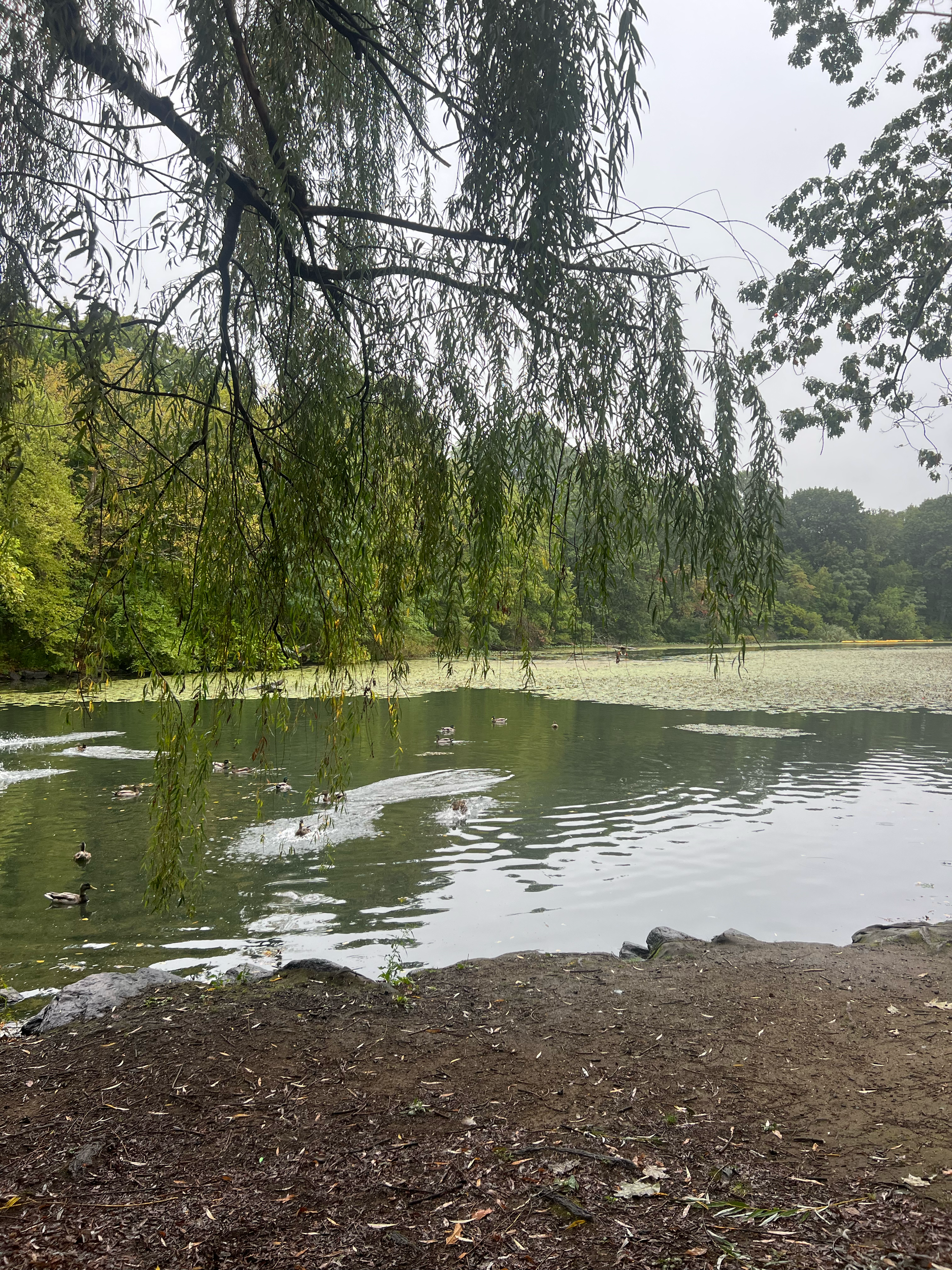
Tibbet’s Brook in the Bronx. A major daylighting project for underground sections of the brook is scheduled to begin in fall 2026.
That vote matters for how municipal officials should read the Amendment. If it meant only that government ought to keep doing whatever existing law already requires, it would add nothing, and it makes no sense to think that voters amended the Bill of Rights in order to preserve the status quo. The NYS Bar Association task force that helped shape the Amendment recommended a self-executing right, enforceable against the state without waiting for another statute.[4] The Amendment was meant to raise the floor on environmental protection in the state.
It also applies to decisions municipalities already make. Zoning, permitting, siting, and capital spending all happen under a constitution that guarantees every person a right to a healthful environment. Officials who take an oath to support that constitution have reason to treat the right as a working consideration now, rather than waiting for courts to tell them how much it requires.
In practice, municipalities can use the Amendment to:
ground legislative findings and statements of purpose in a constitutional right, not only a policy preference;
give weight to environmental and health impacts in discretionary decisions such as facility siting, environmental review, and capital priorities; and
justify prioritizing neighborhoods already carrying a disproportionate share of pollution.
How municipalities use the Amendment will also shape what it comes to mean. Courts interpreting a new constitutional right often look to how it has been understood and applied, and local governments that build it into their findings and decisions help establish that understanding.
The Amendment’s limits are, however, real, and a defensible ordinance should respect them. As in other states with Green Amendments, it will take years or decades for New York’s courts to settle on an interpretation and on enforcement mechanisms. In People v. Norlite, the Third Department rejected the argument that the Amendment creates a new environmental standard above New York’s existing permitting laws.[5] That counsels against writing a local ordinance as though the Amendment overrides an established state regulatory system. A few months later, in East Side Parkways Coalition, the Fourth Department allowed a Green Amendment claim against state transportation officials to proceed,[6] while leaving open whether the Amendment can always be enforced directly without another statute. The few other courts to address it have held that it can support constitutional claims against government action, with limitations, especially regarding the discretionary powers of public authorities.[7][8] Until the Court of Appeals provides a general test, municipalities should treat the Amendment as supporting authority rather than a stand-alone source of regulatory power.
Municipalities can act now
Municipalities can enact environmental ordinances now, with the Green Amendment as support. If every municipality waits for the Court of Appeals to answer every possible question, the Amendment will turn into little more than a legal artifact, left to gather dust. Yet now is precisely when it is needed most: neighborhoods are currently dealing with asthma, heat, flooding, contaminated water, truck traffic, and cumulative pollution.
Article IX of the New York Constitution and the Municipal Home Rule Law give municipalities broad authority to enact laws regarding the well-being of people and property.[9] That authority predates the Green Amendment and remains the starting point for most local ordinances. The Municipal Home Rule Law also protects and enhances a municipality’s physical environment.[10] Certain municipal charters and subject-specific state laws may also grant municipalities additional authority to act now.
These broad sources of authority come with one major caveat that can stop even a well-researched ordinance: preemption. A municipality may not contradict a generally applicable state law, regulate a field the state legislature has fully occupied, or make it impossible to comply with both state and local requirements. Preemption limits home rule authority and defines the lane in which municipalities can enact environmental ordinances, but it is not a reason to do nothing.
In Glen Oaks Village Owners, the Court of Appeals held that New York’s climate statute does not occupy the entire field of greenhouse gas regulation, so complementary ordinances, such as New York City’s Local Law 97 (Greenhouse Gas Emissions Reduction), can remain in place, although the validity of each ordinance still depends on specific provisions and the applicable state law.[11] That leaves municipalities room to address building emissions alongside state climate policy. Energy Law § 11-109 is a more direct example of the lane New York municipalities can legislate in without running into preemption: municipalities may adopt energy-conservation construction codes that are stricter than the state code, but not broader.[12]
The risk of preemption involves a degree of uncertainty, but local governments can exercise strong authority through home rule, zoning, building codes, sanitation codes, procurement, infrastructure, their own charters, and the provision of municipal services. Municipalities can enact laws affecting health and safety within their borders, and the Green Amendment gives them a compelling reason to do so now because it expressly ties the health of New York’s environment to the health, safety, and rights of New Yorkers.
What this looks like in practice
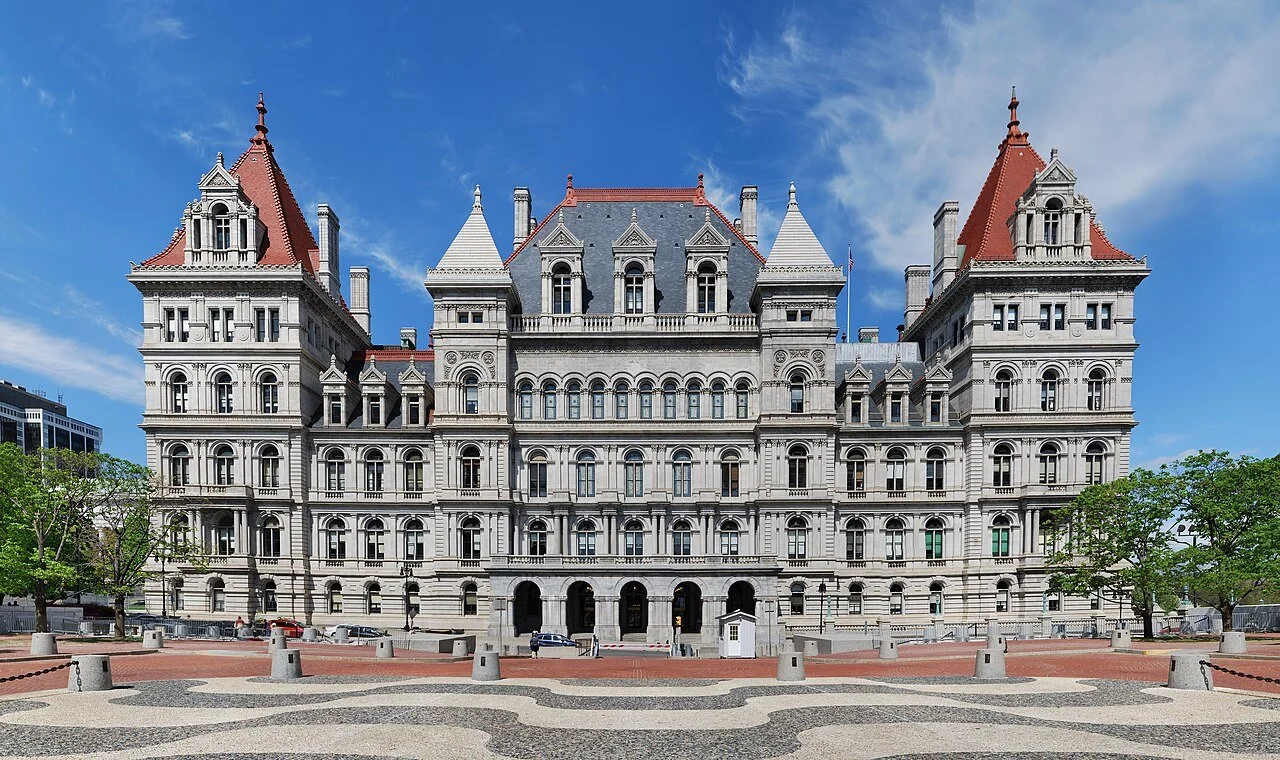
New York State Capitol viewed from the south, located on the north end of the Empire State Plaza in Albany, New York. Photo credit: Matt Wade Photography, Creative Commons Attribution 3.0, via Wikimedia Commons.
For most people, environmental governance shows up through ordinary municipal systems: pollution from the building next door, the storm drain at the end of the block, the wetland that keeps a neighborhood from flooding, or the truck route past a school. New York City already acts in each of these settings: Local Law 97 limits emissions from large buildings.[13] The Bluebelt program uses streams, ponds, and wetlands to manage stormwater.[14] The city’s anti-idling law sets a one-minute limit near schools to reduce vehicle emissions where children are present.[15]
In the Bluebelt program, the city treats ecological function as part of its infrastructure. Wetlands and waterways store and move stormwater; protecting them is part of flood management, an issue within coastal cities’ home rule authority. New York City’s flood strategy depends on the wetlands’ continuing ecological function. That same idea can inform land-use and capital decisions elsewhere, with the Green Amendment as support.
Cities in other states offer further models. To cite just a few examples: Sacramento funded neighborhood air monitoring to fill gaps left by existing programs.[16] Benicia, California, requires reporting and local oversight at high-hazard industrial facilities.[17] Cincinnati gives workers, firefighters, officials, and residents access to information about toxic and hazardous substances.[18] Boston regulates building emissions.[19] Each ties a defined local problem to a municipal power already available in that city, without contradicting its state’s law.
Even if direct environmental regulation is not permitted, municipalities can still act through their own property, contracts, capital spending, data collection, or land-use decisions that state law typically allows, citing the Green Amendment to support the constitutional interest at stake.
A short checklist for municipal officials
Durable ordinances need a defensible source of authority beyond the Green Amendment. The ordinance should be tied to specific local conditions, and the implementation plan must be workable.
1. Map authority before drafting. Identify the municipality’s source of authority before settling on the policy design: home rule, the charter, zoning or building law, or another enabling statute. Then, check county, state, and federal law covering the same subject to avoid preemption issues.
2. Build the record around the municipality. Use tangible evidence that describes the place the ordinance will affect: air and water data, health information, flood maps, planning documents, and public testimony. Where ecological function matters (as in the Bluebelt example), document it in the record. A 2026 review of 67 studies across 83 cities found that none included the pre-intervention biodiversity assessments needed to reliably measure ecological gains, which makes an ordinance regulating that sector easier to challenge.[20] If a municipality relies on a wetland, tree canopy, or another living system to perform public functions, such as flood management or temperature regulation, actual data in the record, with a plan to monitor changes, makes the ordinance much harder to challenge.
3. Tightly match the legal tool to the problem. If the siting of truck-heavy facilities such as warehouses or waste transfer stations is the problem, use zoning and connect the restriction to the comprehensive plan. If direct regulation in this way is constrained, consider procurement, contracting, municipal property, utility operations, infrastructure, public information, monitoring, fees, or incentives. Local government acts in many capacities, each of which can be considered in light of environmental protection.
4. Draft with precise implementation standards. Once the authority, scope, and method are clear, the ordinance still must work in practice. Follow SEQRA and local notice, hearing, referral, and planning requirements. The draft must use evidence-based standards, explain exemptions, and assign responsibility for administration, reporting, inspections, compliance, and penalties. The ordinance should include a severability clause in case parts of it are found invalid, and a savings clause stating that the ordinance supplements other legal requirements. Procedure matters. The Green Amendment should serve as the throughline tying these requirements together, with the purpose of protecting residents’ health and safety by protecting the environment.
From the Constitution to the municipality
The New York Green Amendment’s value lies in bringing consideration of environmental harm into the room through the door of residents’ health and safety. New York courts will continue to define the Amendment and its scope. Cities, towns, and villages do not need to resolve every doctrinal question before using lawful municipal powers, with the Green Amendment in view, to pass defensible, beneficial ordinances.
Sources
[1] N.Y. Const. art. I, § 19, https://www.nysenate.gov/legislation/laws/CNS/A1S19.
[2] New York State Senate, S. 528 Sponsor Memorandum and Bill Text (2021), https://www.nysenate.gov/legislation/bills/2021/S528.
[3] New York State Board of Elections, 2021 General Election, Proposal 2: Right to Clean Air, Clean Water, and a Healthful Environment, https://results.elections.ny.gov/contest/592.
[4] New York State Bar Association Environmental and Energy Law Section, Report and Recommendations Concerning Environmental Aspects of the New York State Constitution, 38 Pace L. Rev. 182 (2017), https://digitalcommons.pace.edu/plr/vol38/iss1/10/.
[5] People v. Norlite, LLC, 246 A.D.3d 1346 (3d Dep’t 2026), https://www.nycourts.gov/reporter/3dseries/2026/2026_01105.htm.
[6] East Side Parkways Coalition v. New York State Department of Transportation, 2026 N.Y. Slip Op. 04562 (4th Dep’t July 24, 2026), https://www.nycourts.gov/reporter/current/3dseries/2026/2026_04562.shtml.
[7] Friends of Fort Greene Park v. New York City Parks & Recreation Department, 87 Misc. 3d 1064 (Sup. Ct. N.Y. County 2025), https://www.nycourts.gov/reporter/3dseries/2025/2025_25151.htm.
[8] Police Benevolent Ass’n of the City of New York, Inc. v. City of New York, 40 N.Y.3d 417 (2023), https://www.nycourts.gov/reporter/3dseries/2023/2023_05960.htm.
[9] N.Y. Const. art. IX, § 2, https://www.nysenate.gov/legislation/laws/CNS/A9S2.
[10] N.Y. Municipal Home Rule Law § 10, https://www.nysenate.gov/legislation/laws/MHR/10.
[11] Glen Oaks Village Owners, Inc. v. City of New York, 44 N.Y.3d 468 (2025), https://www.nycourts.gov/reporter/3dseries/2025/2025_03101.htm.
[12] N.Y. Energy Law § 11-109, Municipal regulations, https://www.nysenate.gov/legislation/laws/ENG/11-109.
[13] New York City Local Law No. 97 of 2019, https://www.nyc.gov/assets/buildings/local_laws/ll97of2019.pdf.
[14] New York City Department of Environmental Protection, The Bluebelt Program, https://www.nyc.gov/site/dep/water/the-bluebelt-program.page.
[15] New York City, Local Law No. 5 of 2009, Engine Idling, https://legistar.council.nyc.gov/LegislationDetail.aspx?ID=452132&GUID=C51E7B55-9592-4F73-9E08-99526EDD4DC9.
[16] City of Sacramento, Community Air Quality Monitoring Pilot, File No. 2021-00999 (2021), https://sacramento.granicus.com/MetaViewer.php?view_id=22&clip_id=5052&meta_id=645099.
[17] City of Benicia, Ordinance No. 25-4, Industrial Health and Safety, https://www.ci.benicia.ca.us/vertical/sites/%7BF991A639-AAED-4E1A-9735-86EA195E2C8D%7D/uploads/Ordinance_25-4_-_Adding_Ch._8.55_Industrial_Health_and_Safety.pdf.
[18] Cincinnati Code of Ordinances ch. 1247, Toxic Chemical Right-to-Know, https://library.municode.com/oh/cincinnati/codes/code_of_ordinances?nodeId=TITXIICIFIPRCO_CH1247TOHASUIGKN.
[19] City of Boston, Building Emissions Reduction and Disclosure Ordinance 2.0, https://www.boston.gov/sites/default/files/file/2023/12/BERDO%202.0%20Final%20Amended%20Docket%200775_1.pdf.
[20] Aisiri Amin, Study finds urban nature-based solutions overlook biodiversity, Mongabay-India (2026), https://india.mongabay.com/2026/03/study-finds-urban-nature-based-solutions-overlook-biodiversity/.